
What is Blood Grouping and Rh Typing Test?
The Blood Grouping and Rh Typing Test is a basic yet critically important laboratory test that identifies a person’s blood group (A, B, AB, or O) along with their Rh status (positive or negative).
In everyday clinical practice, this test forms the foundation for safe blood transfusion, pregnancy care, and emergency treatment planning. It is often one of the first blood tests performed in hospitals because knowing a patient’s blood type can be life-saving in urgent situations.
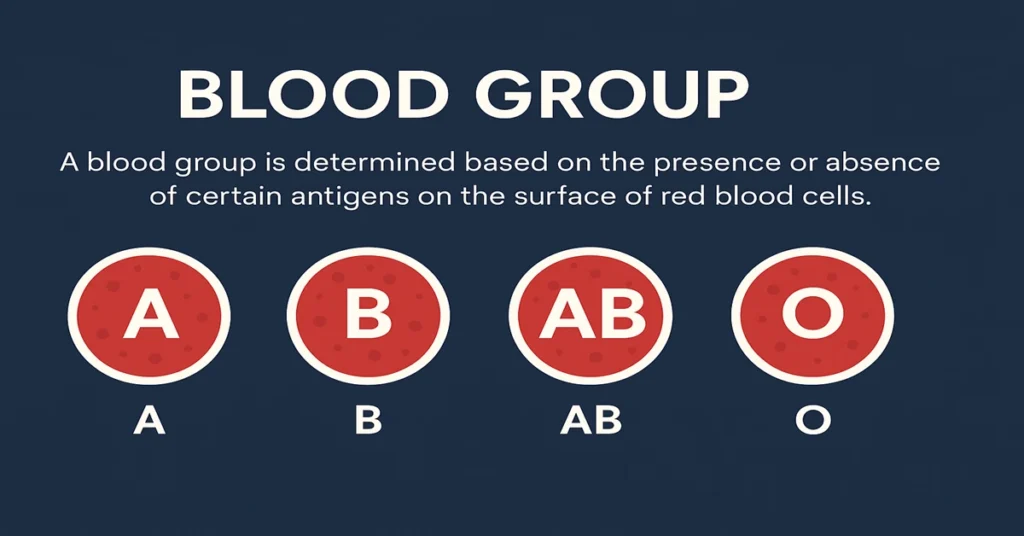
Blood grouping is based on the ABO system, which looks for specific antigens—A and B—on the surface of red blood cells. If A antigen is present, the blood group is A; if B antigen is present, the group is B; if both are present, the group is AB; and if neither is present, the group is O.
Rh typing focuses on the presence or absence of the Rh (D) antigen. When this antigen is present, the blood type is Rh-positive; when it is absent, the blood type is Rh-negative.
Together, ABO grouping and Rh typing define a person’s complete blood type, such as O⁺, A⁻, AB⁺, or B⁻.
Where It Is Synthesized/Produced in the Body
Blood group characteristics are genetically inherited and are determined at birth. They are not produced by any organ in the traditional sense, nor are they influenced by diet, lifestyle, or environmental factors.
The genes responsible for ABO and Rh blood groups are passed down from both parents. Each individual inherits one gene from the mother and one from the father, and the combination of these genes decides the final blood group.
These antigens are expressed on the membrane of red blood cells and remain constant throughout life. In routine clinical settings, a person’s blood group does not change. Only in rare situations, such as after a bone marrow transplant, can blood group characteristics alter.
Main Functions and Importance
Blood grouping and Rh typing are essential for several reasons, most of which relate directly to patient safety.
The most important role of this test is to ensure safe blood transfusion. If incompatible blood is transfused, the recipient’s immune system may destroy the donor red blood cells, leading to a severe and potentially fatal transfusion reaction.
In pregnancy, Rh typing has special importance. When a mother is Rh-negative and the fetus is Rh-positive, there is a risk of the mother developing antibodies against the baby’s red blood cells. Identifying this mismatch early allows preventive care to protect future pregnancies.
This test is also routinely required before major surgeries, organ transplantation, and invasive medical procedures where blood loss is anticipated. In emergency and trauma care, knowing the blood group in advance can save valuable time.
From a broader perspective, blood grouping also helps identify universal donors and recipients, which is crucial in blood bank management and disaster medicine.
Causes of Low/Negative Results
In blood grouping, the concept of “low” values does not apply because blood groups are qualitative, not numerical.
However, a Rh-negative result means that the Rh (D) antigen is absent on the red blood cells. This is a normal genetic variation and not a disease or deficiency.
Rh-negative individuals are completely healthy. The clinical significance arises only in specific situations such as blood transfusion or pregnancy.
Symptoms or Implications of Low/Negative Result
A Rh-negative blood type does not cause symptoms by itself. The concern is related to immune response during exposure to Rh-positive blood.
In transfusion settings, if a Rh-negative person receives Rh-positive blood, their immune system may form antibodies. This may not cause immediate problems but can lead to serious reactions in future transfusions.
In pregnancy, an Rh-negative mother carrying a Rh-positive baby may develop antibodies that can affect subsequent pregnancies. This risk is well understood and routinely managed in modern medical care.
Causes of High/Positive Results
A Rh-positive result simply indicates the presence of the Rh antigen on red blood cells. This is the most common finding worldwide and is considered entirely normal.
In ABO grouping, a “positive” reaction refers to visible agglutination when blood is mixed with specific antisera. This clumping confirms the presence of the corresponding antigen and defines the blood group.
These findings are expected laboratory outcomes and do not represent disease or abnormality.
Symptoms or Implications of High/Positive Results
There are no symptoms associated with being Rh-positive or belonging to any specific ABO group.
Rh-positive individuals can safely receive Rh-positive blood, and Rh incompatibility is not a concern during pregnancy when both mother and baby are Rh-positive. The result simply reflects a normal genetic trait.
Reference Ranges
Blood grouping does not have numeric reference ranges.
The expected results are:
- ABO group: A, B, AB, or O
- Rh type: Positive or Negative
All blood groups are normal. Medical relevance lies in compatibility, not in whether a group is considered “high” or “low.”
Sample Type and Testing Procedure
The test is performed using a small blood sample, obtained either from a vein in the arm or by finger prick.
In the laboratory, the blood sample is mixed with specific antisera—Anti-A, Anti-B, and Anti-D. The presence or absence of agglutination is observed. Agglutination indicates that the corresponding antigen is present on the red blood cells.
Modern laboratories often use automated analyzers and standardized methods to improve accuracy and reduce human error, especially in transfusion services.
Test Preparation
No fasting or special preparation is required for this test.
The sample must be collected using proper sterile technique. In transfusion or donation settings, blood grouping is always followed by cross-matching to ensure full compatibility.
When to Consult a Doctor
You should discuss blood group and Rh typing results with your doctor if you are pregnant, planning surgery, donating blood, or have a history of transfusion reactions.
Medical advice is also important if there is any uncertainty about blood type documentation or if transfusion-related symptoms such as fever, chills, back pain, or jaundice occur after receiving blood.
Important Word Explanations
- Antigen: A protein on red blood cells that determines blood type.
- Agglutination: Clumping reaction used to identify blood group antigens.
- Rh Factor (D Antigen): Protein that defines Rh-positive or Rh-negative status.
- Hemolytic Disease of the Newborn (HDN): Condition caused by Rh incompatibility between mother and baby.
- Cross-Matching: Final compatibility testing between donor and recipient blood before transfusion.
~END~
Related Posts
None found