
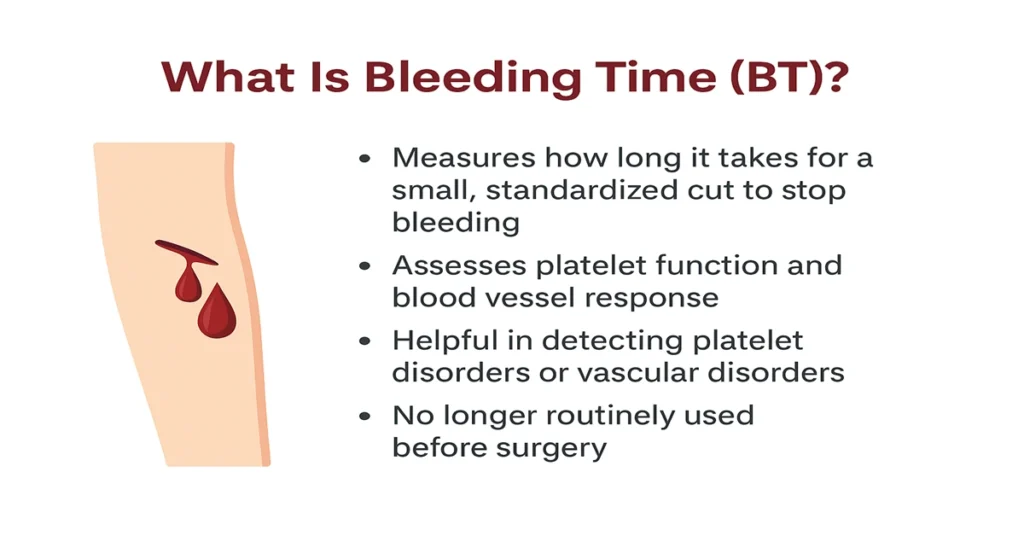
What is Bleeding Time (BT)?
Bleeding Time (BT) is a traditional clinical test that measures how long bleeding continues after a small, standardized cut or puncture is made on the skin. It reflects how effectively platelets and small blood vessels work together to stop bleeding at the site of injury—a process known as primary hemostasis.
This test does not assess clotting factors (which are evaluated by tests like PT or aPTT). Instead, it focuses on platelet function and the immediate response of the blood vessels. Historically, BT was used as a general screening tool for bleeding risk, especially before surgery. Today, because of variability and limited precision, it has largely been replaced by more reliable platelet function tests such as the Platelet Function Analyzer (PFA) or platelet aggregation studies.
Where It Is Controlled or Produced in the Body
Bleeding time reflects the coordinated action of platelets and blood vessels rather than a substance produced in a single organ.
Platelets
Platelets are formed in the bone marrow from megakaryocytes. When a blood vessel is injured, platelets quickly adhere to the damaged surface, become activated, and aggregate to form an initial plug that slows and then stops bleeding.
Blood Vessel Walls
Small vessels respond immediately to injury by constricting. This narrowing reduces blood flow and exposes signals—such as von Willebrand factor—that help platelets attach and function effectively.
Clotting Factors (from the Liver)
Although clotting factors stabilize the clot later, they are not directly assessed by bleeding time. BT primarily reflects the early, platelet-driven phase of hemostasis.
In short, bleeding time evaluates platelet behavior and vessel response, not the full coagulation cascade.
Main Functions and Importance of the Bleeding Time Test
Assessment of Platelet Function
BT provides a basic indication of how well platelets adhere and aggregate at an injury site.
Detection of Platelet or Vascular Problems
Prolonged bleeding time can point toward reduced platelet numbers, impaired platelet function, or abnormalities in small blood vessels.
Medication Effect
Drugs that affect platelet activity—such as aspirin and other antiplatelet agents—often prolong bleeding time. This makes BT useful for understanding drug effects on primary hemostasis.
Historical Surgical Screening
Bleeding time was once routinely used before procedures. Due to inconsistency and limited predictive value, it is no longer recommended for routine pre-operative screening.
Today, BT is mainly used when advanced platelet testing is unavailable or for educational and illustrative purposes.
Causes of Low (Shorter) Bleeding Time
A shortened bleeding time is uncommon and generally has little clinical relevance. It may reflect a brisk platelet response or strong vessel constriction.
Possible contributing factors include temporary stress-related changes or increased platelet reactivity. These findings are usually incidental.
Symptoms of Low Bleeding Time
Short bleeding time does not cause symptoms and is not associated with disease. It is typically considered a benign observation.
Causes of High (Prolonged) Bleeding Time
A prolonged bleeding time suggests difficulty forming an effective platelet plug.
Common clinical settings include:
Low Platelet Count (Thrombocytopenia)
When platelet numbers are reduced, plug formation is delayed.
Platelet Function Disorders
Platelets may be present in normal numbers but function poorly, leading to delayed bleeding control.
Von Willebrand Disease
Reduced or dysfunctional von Willebrand factor interferes with platelet adhesion, prolonging bleeding time.
Liver Disease
Although primarily affecting clotting factors, advanced liver disease can also alter platelet function and vessel integrity.
Medications
Aspirin, NSAIDs, and antiplatelet drugs are frequent and reversible causes of prolonged BT.
Uremia (Advanced Kidney Disease)
Accumulated waste products can impair platelet function despite normal platelet counts.
Symptoms of High Bleeding Time
When bleeding time is prolonged, bleeding from minor injuries may last longer than expected.
Patients may notice:
- Easy bruising
- Recurrent nose or gum bleeding
- Prolonged bleeding after cuts or dental work
- Heavy menstrual bleeding
- Small red spots on the skin (petechiae)
These features reflect impaired primary hemostasis rather than the test itself.
Reference Ranges
Reference values vary by technique, but typical ranges are:
- Normal: 2–7 minutes
- Prolonged: More than about 7–8 minutes, suggesting impaired platelet or vessel function
- Shortened: Less than 2 minutes, usually of no clinical significance
Results must always be interpreted in clinical context.
Sample Type and Procedure
Bleeding time is a skin-based test, not a blood draw.
Procedure:
A small, standardized cut is made on the forearm. Bleeding is gently blotted at fixed intervals, and the total time until bleeding stops is recorded.
Sample Type:
Skin surface (forearm). No blood sample is collected.
The test is performed by trained personnel using sterile technique.
Test Preparation
No fasting is required.
Patients are usually advised to avoid aspirin or similar medications for several days beforehand, if medically appropriate.
Any known bleeding disorders or liver or kidney disease should be discussed with the clinician before testing.
When to Consult a Doctor
Medical advice should be sought if there is:
- Unexplained or frequent bruising
- Prolonged bleeding after minor injuries
- Recurrent nose or gum bleeding
- Heavy menstrual bleeding
- A family history of bleeding disorders
If bleeding time is prolonged, doctors often follow up with more specific tests, such as platelet count, PT, aPTT, von Willebrand factor studies, or modern platelet function assays.
Important Word Explanations
- Hemostasis: The body’s process of stopping bleeding
- Platelets: Small blood components that form the initial clot
- Thrombocytopenia: Low platelet count
- Von Willebrand Factor (vWF): Protein that helps platelets adhere to vessel walls
- Antiplatelet Drugs: Medications that reduce platelet activity
- Uremia: Accumulation of waste products in kidney failure that can impair platelet function
~END~
Related Posts
None found