
Bilirubin Total Test: Meaning, Normal Range, High & Low Bilirubin Causes, Symptoms, and Complete Medical Guide
What Is Bilirubin Total?
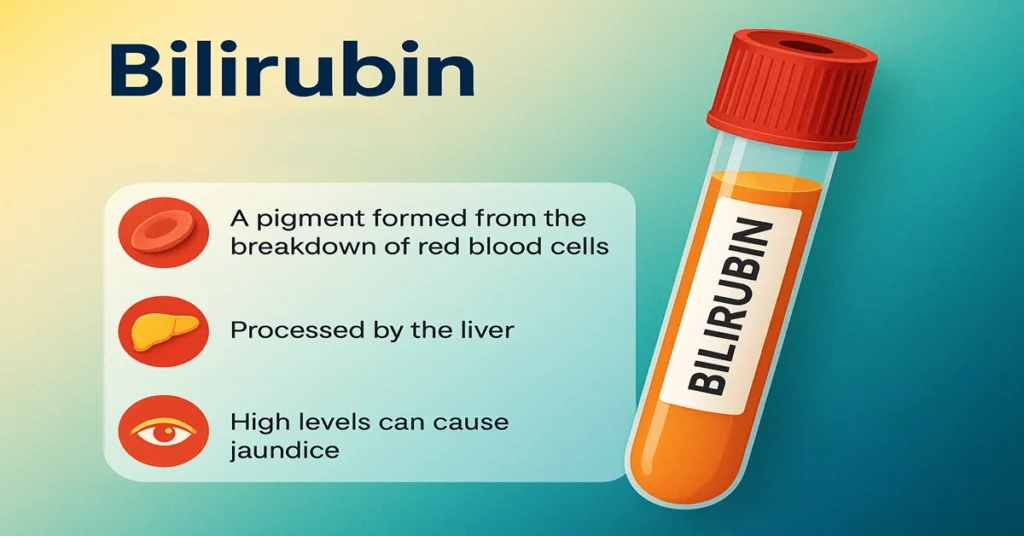
Bilirubin is a yellow-orange pigment that forms naturally when red blood cells complete their normal lifespan and are broken down by the body. The Total Bilirubin Test measures the combined level of two forms of bilirubin circulating in the blood:
Unconjugated (Indirect) Bilirubin
This form is produced during red blood cell breakdown, before the liver processes it. It is not water-soluble.
Conjugated (Direct) Bilirubin
This form has been processed by the liver, made water-soluble, and prepared for removal from the body.
By measuring total bilirubin, doctors gain insight into how well red blood cells are breaking down, how effectively the liver is processing waste, and whether bile flow is functioning normally. For this reason, bilirubin testing is a routine part of liver function evaluation.
Where Is Bilirubin Produced in the Body?
Bilirubin formation and clearance involve a coordinated process across several organs.
Formation of Unconjugated Bilirubin
As red blood cells age, they are removed mainly by the spleen, with contributions from the liver and bone marrow. Hemoglobin released from these cells is converted into unconjugated bilirubin. At this stage, bilirubin cannot be eliminated directly from the body.
Processing in the Liver
Unconjugated bilirubin travels through the bloodstream to the liver. Liver cells convert it into conjugated bilirubin, a form that can dissolve in water.
Excretion Through Bile
Conjugated bilirubin is passed into bile, moves through the bile ducts, and enters the intestines. It is ultimately eliminated from the body, primarily through stool and, to a lesser extent, urine.
Any interruption at these stages—breakdown, processing, or excretion—can lead to changes in blood bilirubin levels.
Main Functions and Importance of the Bilirubin Test
Bilirubin itself is a waste product, but its measurement provides valuable clinical information.
Evaluates Liver Health
Elevated bilirubin may indicate that liver cells are not processing waste efficiently, which can occur in various liver conditions.
Detects Bile Flow Problems
Blockages or narrowing of bile ducts can prevent bilirubin from reaching the intestines, leading to accumulation in the blood.
Assesses Red Blood Cell Turnover
Increased destruction of red blood cells raises unconjugated bilirubin levels, offering clues about blood-related conditions.
Important in Newborn Care
Bilirubin testing is essential in newborns, whose liver enzymes may not yet be fully mature.
Supports Medication Monitoring
Some medicines affect liver processing. Bilirubin levels can help identify early changes in liver handling of waste products.
Because bilirubin reflects multiple body systems, it is commonly included in liver function test panels.
Causes of Low Bilirubin Levels
Low bilirubin levels are usually not clinically significant. They typically indicate reduced bilirubin concentration in the blood rather than disease.
Possible contributing factors may include dilution of blood due to high fluid intake or temporary laboratory variations. In routine practice, low bilirubin rarely requires further investigation unless other test results are abnormal.
Symptoms of Low Bilirubin
Low bilirubin does not produce symptoms. It is generally considered a normal variation and does not indicate illness on its own.
Causes of High Bilirubin Levels (Hyperbilirubinemia)
High bilirubin levels suggest that one or more steps in bilirubin handling are affected.
Liver-Related Conditions
When liver cells are inflamed or damaged, bilirubin processing becomes inefficient, leading to elevated levels.
Bile Duct Obstruction
If bile flow is blocked, conjugated bilirubin cannot be excreted and builds up in the bloodstream.
Increased Red Blood Cell Breakdown
Rapid destruction of red blood cells produces excess unconjugated bilirubin that exceeds the liver’s processing capacity.
Inherited Processing Variations
Some individuals have mild genetic differences in bilirubin metabolism, resulting in intermittent elevation without serious disease.
Newborn Physiology
In newborns, temporary elevation occurs because liver processing systems are still developing.
Clinically, doctors determine whether bilirubin elevation is predominantly direct or indirect to narrow down the cause.
Symptoms of High Bilirubin
Symptoms depend on the degree of elevation and the underlying condition.
Common clinical signs include yellowing of the skin or eyes, dark urine, lighter-colored stools, itching, fatigue, or abdominal discomfort. These features prompt further evaluation to identify the source of bilirubin accumulation.
Bilirubin Reference Ranges
Reference ranges may vary slightly between laboratories, but commonly used values include:
Total Bilirubin
Normal: 0.3 – 1.2 mg/dL
Direct (Conjugated) Bilirubin
Normal: 0.1 – 0.4 mg/dL
Indirect (Unconjugated) Bilirubin
Normal: 0.2 – 0.8 mg/dL
Doctors interpret these values together rather than in isolation.
Sample Type and Collection
- Sample Type: Serum
- Tube Used: Red-top plain tube
Blood is drawn from a vein, allowed to clot, and then processed to obtain serum for bilirubin measurement.
Test Preparation
Short fasting may be advised before testing, as recent meals can influence results. Alcohol intake before the test may affect liver handling of bilirubin and is usually avoided.
Doctors also consider current medications, recent illness, and hydration status when interpreting bilirubin values.
When to Consult a Doctor
Medical consultation is recommended if bilirubin levels remain elevated on repeat testing or if symptoms such as yellowing of the eyes or skin, dark urine, pale stools, persistent fatigue, or abdominal discomfort appear.
Early evaluation helps determine whether the elevation is temporary or related to liver, bile duct, or blood-related conditions.
Important Word Explanations
- Hemolysis: Accelerated breakdown of red blood cells.
- Gilbert’s Syndrome: A mild inherited condition affecting bilirubin processing.
- Conjugated Bilirubin: Water-soluble bilirubin processed by the liver.
- Unconjugated Bilirubin: Fat-soluble bilirubin formed during red blood cell breakdown.
- Hyperbilirubinemia: Elevated bilirubin levels in the blood.
~END~