
What is the BCR-ABL Gene?
The BCR-ABL gene is an abnormal fusion gene that forms when a segment of the BCR gene on chromosome 22 joins with a segment of the ABL gene on chromosome 9. This event creates a shortened chromosome known as the Philadelphia chromosome.
This fusion leads to continuous production of an abnormal tyrosine kinase enzyme. Unlike normal enzymes that switch on and off as needed, this one stays active. As a result, bone marrow cells receive constant signals to multiply, leading to excessive production of white blood cells. This mechanism is central to certain blood cancers, most notably Chronic Myeloid Leukemia (CML) and some cases of Acute Lymphoblastic Leukemia (ALL).
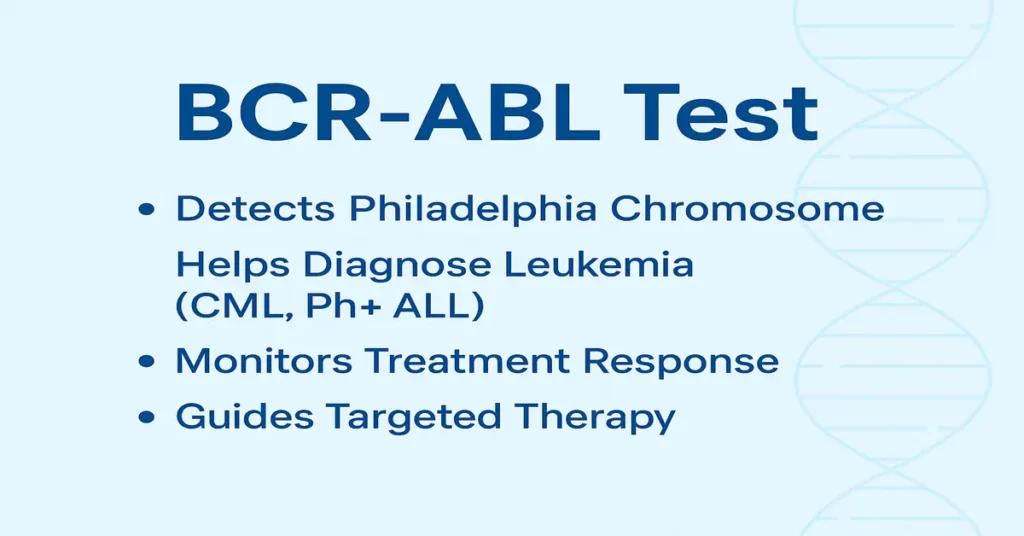
The BCR-ABL test identifies whether this fusion gene is present and, when required, measures its level. Clinically, this information is used to confirm diagnosis and to understand how the disease is behaving over time.
Where is BCR-ABL Formed in the Body?
The BCR-ABL gene is not inherited. It develops during life due to a random genetic change in bone marrow stem cells—the cells responsible for making blood components.
This change occurs through a process called reciprocal translocation, where parts of chromosomes 9 and 22 exchange places. Once this rearrangement happens, the newly formed BCR-ABL gene begins driving uncontrolled cell growth. From a laboratory perspective, this explains why the abnormality is confined to blood-forming tissues rather than being present in every cell of the body.
Purpose and Importance of the BCR-ABL Test
The BCR-ABL test is a cornerstone investigation in leukemia care. It supports several critical clinical decisions.
1. Diagnosis
Detection of the BCR-ABL fusion gene confirms the presence of the Philadelphia chromosome. This finding is characteristic of:
- Chronic Myeloid Leukemia (CML)
- Philadelphia-positive Acute Lymphoblastic Leukemia (Ph+ ALL)
A positive result helps define the exact leukemia type, which is essential for choosing the correct management pathway.
2. Treatment Guidance
The presence of BCR-ABL explains why certain targeted medicines, known as tyrosine kinase inhibitors (TKIs), are effective. These drugs are designed to block the abnormal enzyme produced by the fusion gene. Identifying BCR-ABL therefore helps clinicians select therapies that directly address the disease mechanism rather than using non-specific treatments.
3. Monitoring Treatment Effectiveness
Once treatment begins, the test is repeated at regular intervals. From a laboratory standpoint, the trend matters more than a single value. Falling levels suggest good disease control, while stable or rising levels may signal an incomplete response or emerging resistance. This ongoing monitoring allows doctors to adjust treatment before clinical relapse becomes apparent.
Causes of Low or Negative BCR-ABL Levels
A low or negative result generally indicates favorable disease control or absence of disease. Common explanations include:
- No BCR-ABL fusion gene present
- Effective treatment with elimination of most abnormal cells
- Molecular remission, where the gene is below detection limits
- Very early disease with levels too low for detection
In practice, such results are interpreted as reassuring, especially when consistent over time.
Symptoms of Low or Negative BCR-ABL Levels
There are no symptoms directly linked to a negative BCR-ABL result. For patients already on therapy, low or undetectable levels usually reflect effective control of abnormal blood cell production and stabilization of blood counts.
Causes of High or Positive BCR-ABL Levels
A positive or elevated result indicates ongoing presence of leukemia cells carrying the fusion gene. This may be seen:
- At initial diagnosis
- When treatment response is partial
- If resistance to therapy develops
- During relapse after a period of control
Laboratory trends are particularly important here, as gradual increases can precede clinical symptoms.
Symptoms of High or Positive BCR-ABL Levels
Symptoms arise from the leukemia itself rather than the test result. Patients may experience fatigue, weight loss, fever, night sweats, or abdominal fullness due to an enlarged spleen. Changes in blood counts can also lead to bruising, bleeding, or infections. Rising BCR-ABL levels in a treated patient often prompt closer clinical review, even before symptoms become prominent.
Reference Ranges
BCR-ABL results depend on the testing technique and are typically reported using standardized interpretations:
- Negative: No detectable fusion gene
- Positive: Fusion gene detected
- Major Molecular Response (MMR): BCR-ABL ≤ 0.1% on the International Scale
- Complete Molecular Response (CMR): No detectable BCR-ABL at the assay’s sensitivity
These categories help clinicians communicate disease status clearly and consistently.
Sample Type and Collection Method
Testing can be performed on:
- Peripheral blood, commonly used for routine monitoring
- Bone marrow aspirate, often used at diagnosis or when clarification is needed
Blood samples are collected through a routine venous draw. Bone marrow samples are obtained under local anesthesia. No fasting or special preparation is required.
Test Preparation
Normal eating and drinking are allowed before testing. Patients are advised to keep prior reports available, as comparison over time is essential. Ongoing medications should be disclosed so results are interpreted accurately within the treatment context.
When to Consult a Doctor
Medical review is appropriate for anyone diagnosed with CML or Ph+ ALL who is undergoing routine monitoring, or if new symptoms appear. Rising BCR-ABL levels, even without symptoms, warrant timely discussion with a hematologist, as early changes often guide important treatment decisions.
Important Word Explanations
- BCR-ABL: An abnormal fusion gene formed from chromosomes 9 and 22
- Philadelphia Chromosome: The shortened chromosome carrying the BCR-ABL gene
- Tyrosine Kinase: An enzyme involved in cell growth signaling
- CML: A slow-growing blood cancer driven by BCR-ABL
- Ph+ ALL: A fast-growing leukemia with the same genetic change
- Molecular Response: The reduction of BCR-ABL levels during treatment
- Imatinib (Gleevec): A targeted drug that blocks the abnormal enzyme
~END~
Related Posts
None found