
Overview
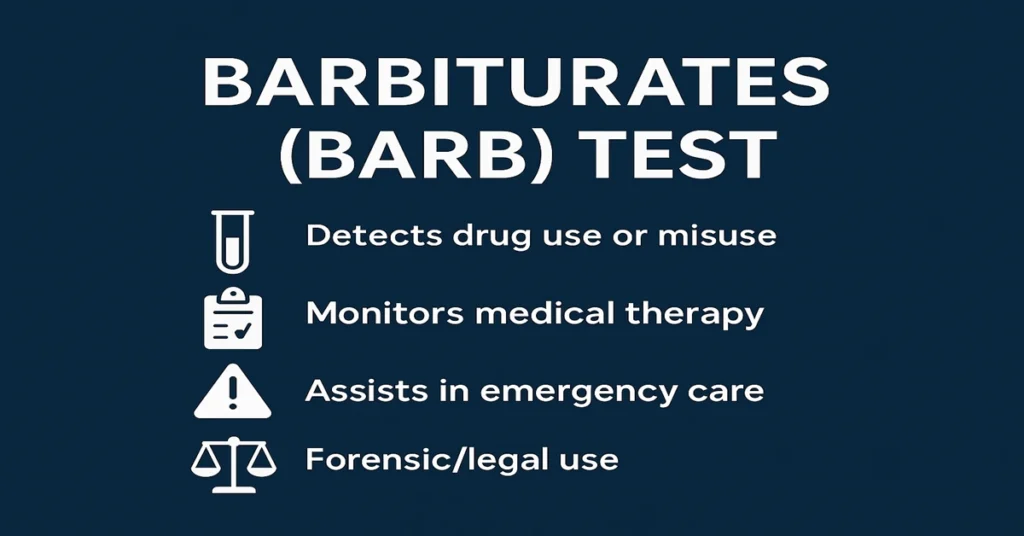
The Barbiturates Test (often called the Barb Test) is a laboratory screening used to identify the presence of barbiturate drugs in the body. Barbiturates are central nervous system depressants that slow brain activity and can cause sedation or sleep. They are still used in selected medical settings—most commonly for seizure control and certain anesthesia-related purposes—though their use today is far less common than in the past.
Because these drugs have a narrow safety margin and can cause serious effects if misused, testing is often requested for clinical monitoring, emergency evaluation, workplace or legal screening, and forensic assessment. In practice, the test helps clinicians understand whether barbiturates may be contributing to a patient’s symptoms or clinical picture.
What Are Barbiturates?
Barbiturates are a class of sedative-hypnotic medications that act on the brain and spinal cord to reduce activity and induce relaxation or sleep. Decades ago, they were widely prescribed for anxiety, insomnia, and seizures. Over time, safer alternatives replaced them because barbiturates carry a higher risk of dependence and toxicity.
Common examples include phenobarbital, secobarbital, amobarbital, pentobarbital, and thiopental. After ingestion, these drugs are processed mainly by the liver and eliminated through the kidneys, which is why urine testing is most frequently used for detection.
Where Barbiturates Come From / How They Enter the Body
Barbiturates enter the body almost exclusively through medication use. This may occur under medical supervision for specific conditions or, less appropriately, through misuse.
Exposure typically comes from prescribed therapy, taking doses higher or more frequent than advised, non-medical or recreational use, or accidental ingestion—particularly in children if medications are not securely stored. Once absorbed, the drugs circulate in the bloodstream and exert a generalized slowing effect on brain and body functions.
Main Functions and Importance of the Barb Test
From a clinical standpoint, the Barbiturates Test serves several important purposes.
First, it helps identify recent use or exposure, which can be crucial when a patient presents with unexplained drowsiness, confusion, or reduced consciousness. Second, in patients who legitimately use barbiturates (such as phenobarbital for epilepsy), testing may support safe medical monitoring. Third, in emergency or forensic settings, the test assists in clarifying whether barbiturates are contributing to poisoning, overdose, or impairment. Finally, it is commonly included in structured drug-screening programs where documentation of substance exposure is required.
Causes of Low or Negative Levels
A negative result indicates that barbiturates are not detectable in the tested sample. This is the expected finding in most individuals.
Low or undetectable levels may also be seen when there has been no recent use, sufficient time has passed for the drug to be cleared, the dose taken was very small, or the concentration falls below the laboratory’s detection threshold. In such cases, the result does not suggest harm or abnormality.
Symptoms of Low or Negative Levels
Low or negative barbiturate levels do not produce symptoms. They simply indicate the absence of measurable drug exposure at the time of testing.
Causes of High or Positive Levels
A positive result means that barbiturates are present above the laboratory cutoff. This may reflect recent prescribed use, repeated or chronic exposure, or ingestion of higher-than-intended amounts. In some situations, combined use with other depressant substances can increase detectable levels and clinical effects.
Clinicians interpret a positive result in the context of the patient’s history, prescription records, and current symptoms.
Symptoms of High / Positive Levels
Elevated barbiturate levels are associated with increased central nervous system depression. Patients may appear unusually drowsy, confused, or unsteady, with slowed speech and poor coordination. As levels rise, breathing and heart rate may become suppressed, and consciousness may be reduced. In severe cases, profound unresponsiveness can occur.
These findings prompt urgent medical evaluation to determine the cause and ensure patient safety.
Reference Ranges (Typical Cutoff Values)
Laboratories report results as either negative or positive based on established cutoff concentrations rather than “normal ranges.” For urine testing, a commonly used cutoff is around 200 ng/mL, though exact values may vary by laboratory and testing method.
Sample Type
Urine is the most commonly used specimen because it reliably reflects recent exposure over several days. Blood samples may be used when current intoxication is suspected, particularly in emergency or legal contexts. In specialized situations, saliva or hair testing may be performed to assess longer-term exposure.
Samples are collected using standard, sterile procedures, and no fasting is required.
Test Preparation
No special preparation is needed before testing. Patients are usually advised to inform the healthcare provider about any prescribed medications, as this information is essential for accurate interpretation. Avoiding non-prescribed sedatives or alcohol before testing can also help prevent confusing results.
When to Consult a Doctor
Medical advice should be sought if barbiturates are being used regularly and unexpected side effects such as excessive drowsiness or confusion develop, or if there is concern about accidental or excessive ingestion. Evaluation is also appropriate when symptoms such as slowed breathing or reduced consciousness appear, or when testing is required for occupational, legal, or medical reasons. In these settings, a clinician can interpret results in context and decide on appropriate next steps.
Important Word Explanations
- Barbiturates: Drugs that depress the central nervous system and cause sedation or sleep.
- Sedative-hypnotic: A substance that calms the nervous system and may induce sleep.
- Overdose: Exposure to a drug amount that produces toxic effects.
- Cutoff value: The concentration above which a test is reported as positive.
- Toxicology: The study of the harmful effects of drugs and chemicals on the body.
- Forensic test: A test performed for legal or investigative purposes.
~END~
Related Posts
None found