
AST Test: Purpose, Importance, Normal Ranges & When It Becomes Risky
What Is the AST Test?
The AST test measures Aspartate Aminotransferase, an enzyme found mainly in the liver, but also in the heart, muscles, kidneys, and brain. Under normal conditions, AST stays inside these cells and only a small amount circulates in the blood.
When cells are injured or inflamed, AST leaks into the bloodstream and its level rises. This is why AST is used as a marker of tissue injury, especially involving the liver and muscles. In routine lab practice, doctors rarely look at AST alone. Instead, they interpret it along with symptoms and other tests to understand what part of the body may be under stress.
Although AST is part of the Liver Function Test (LFT) panel, it is not liver-specific. This makes it useful, but also means it must be interpreted carefully.
Why Is the AST Test Done? (Purpose)
Doctors order the AST test to pick up early signs of tissue stress, often before clear symptoms appear.
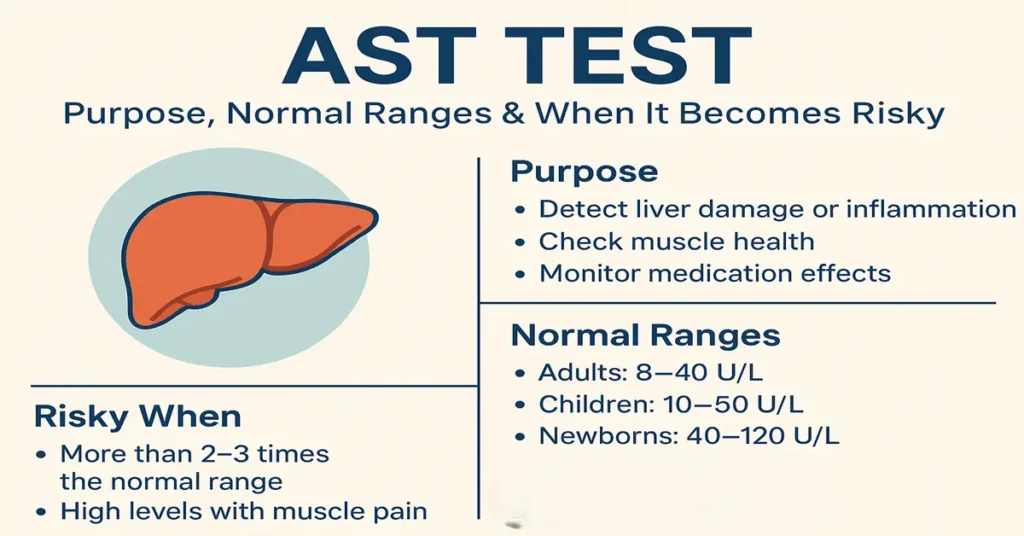
To detect liver damage or inflammation
AST commonly rises in conditions where liver cells are irritated or injured. This includes viral hepatitis, fatty liver disease, alcohol-related liver stress, drug or toxin exposure, and sometimes severe dehydration affecting liver cells. Clinically, AST helps doctors judge how active the inflammation is and whether it is improving or worsening.
To assess muscle health
AST is present in skeletal muscles. Levels can rise after muscle injury, heavy physical exertion, muscle disorders, or severe muscle breakdown. In such cases, AST is usually checked alongside creatine kinase (CK) to distinguish muscle causes from liver causes.
As a supportive marker for heart injury
In the past, AST was widely used in heart attack diagnosis. Today it is no longer the primary test, but it can still support evaluation when muscle or liver involvement is suspected alongside modern cardiac markers.
To monitor medication effects
Many commonly used medicines can irritate liver cells. Painkillers, antibiotics, antifungals, anti-seizure drugs, and cholesterol-lowering medications may affect AST levels. Monitoring helps doctors ensure medications are being tolerated safely.
To track disease progress or recovery
Repeated AST measurements are useful in follow-up. Falling levels often suggest healing, while persistently high values point to ongoing injury.
Why Is the AST Test Important?
Early detection of silent liver problems
Conditions like fatty liver or mild hepatitis may not cause symptoms early on. AST can rise quietly, prompting further evaluation before damage becomes advanced.
Helps separate liver causes from muscle causes
In clinical practice, AST is compared with ALT. When both are high, liver involvement is more likely. When AST is high but ALT is normal or only mildly raised, muscle injury becomes a stronger consideration.
Relevant for people with lifestyle risks
Individuals who consume alcohol, exercise intensely, use supplements, or take long-term medications benefit from periodic AST monitoring to catch early stress.
Useful in pregnancy evaluation
AST may be checked during pregnancy if doctors suspect liver stress, cholestasis, or pregnancy-related metabolic changes. Even mild elevations are taken seriously in this setting.
Normal Ranges of AST
Reference ranges can vary slightly between laboratories, but these values are commonly used.
Adults
Approximately 8–40 U/L
Children
Children may have slightly higher values due to growth and muscle activity, often around 10–50 U/L
Newborns
Newborns naturally have higher AST levels, sometimes up to 40–120 U/L, which usually settle with time
Gender-Based Normal Ranges
There is no major clinical difference between men and women. Minor variations can occur due to muscle mass and hormonal factors.
Men: roughly 10–40 U/L
Women: roughly 8–35 U/L
Pregnancy Range
AST usually stays within the normal adult range during pregnancy, though slight variations may occur.
Typical pregnancy range: about 8–32 U/L
Any persistent rise needs evaluation to rule out liver stress or pregnancy-related conditions.
Symptoms of High AST Levels
AST itself does not cause symptoms. Any symptoms come from the underlying condition. Commonly reported complaints include fatigue, nausea, abdominal discomfort, yellowing of the eyes or skin, dark urine, muscle pain or weakness, loss of appetite, and swelling in advanced cases.
Clinically, doctors correlate these symptoms with AST levels and other test results before drawing conclusions.
When Does AST Become Risky?
AST becomes concerning based on how high it is, how long it stays high, and what other tests show.
A rise to more than two to three times the upper limit suggests active liver or muscle injury.
Persistent elevation over weeks indicates an ongoing process.
Very high levels, often above 300–500 U/L, may be seen in acute hepatitis, significant alcohol-related injury, severe muscle damage, viral infections, or drug toxicity.
High AST along with high ALT strongly points toward liver inflammation.
High AST with muscle pain suggests muscle injury or breakdown.
Any elevation during pregnancy requires prompt evaluation.
What Tests Are Done Along with AST?
To understand the cause, doctors usually combine AST with other investigations such as ALT, ALP, bilirubin, GGT, creatine kinase (CK), a complete metabolic panel, abdominal ultrasound, and viral hepatitis markers. Together, these provide a clearer picture of liver and muscle health.
Test Preparation
The AST test is simple and usually does not require fasting. Alcohol should be avoided for at least 24–48 hours before testing. Heavy workouts should be skipped the day before, as they can raise AST. Inform the doctor about all medications and supplements, and stay well hydrated.
When to Consult a Doctor
Medical advice is recommended if AST remains consistently high, if symptoms like jaundice or extreme fatigue appear, if there is unexplained muscle pain, if you are on long-term medications affecting the liver, or if AST is elevated during pregnancy. A history of fatty liver, alcohol use, or abnormal results in other liver tests also warrants evaluation.
Important Word Explanations
AST (Aspartate Aminotransferase): An enzyme released into blood when liver or muscle cells are injured
ALT: A liver-specific enzyme used alongside AST
LFT: Liver Function Test panel
Cholestasis: Reduced or blocked bile flow
Rhabdomyolysis: Severe muscle breakdown
Inflammation: The body’s response to injury or irritation
People Also Ask
Is a high AST result always serious?
Not always. Mild or temporary rises are common and often settle on their own.
Can AST increase after exercise?
Yes. Intense or unaccustomed exercise can temporarily raise AST due to muscle strain.
Does high AST always mean liver disease?
No. Muscle injury and other tissue damage can also raise AST.
When do doctors worry most about AST?
When levels stay high, rise rapidly, or are accompanied by symptoms and other abnormal tests.
Is repeat AST testing common?
Yes. Repeat testing helps confirm trends and assess recovery.
Can AST return to normal on its own?
In many cases, yes—especially when the cause is temporary and resolves naturally.
~END~