
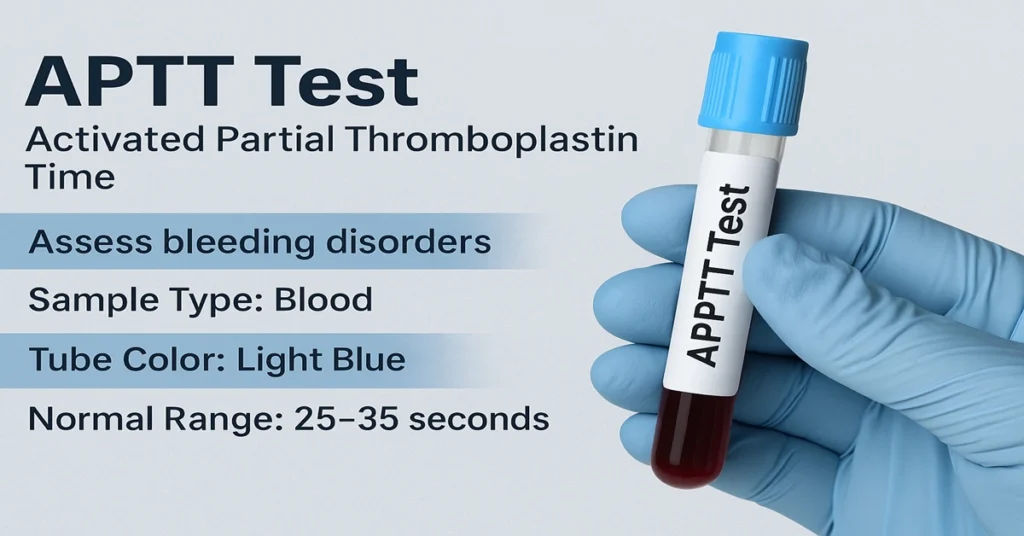
What is APTT (Activated Partial Thromboplastin Time)?
APTT, or Activated Partial Thromboplastin Time, is a laboratory blood test that measures how long it takes for blood to clot under controlled conditions. It evaluates the intrinsic and common pathways of the coagulation cascade, which are essential for normal clot formation.
In everyday clinical practice, the APTT test is used to understand whether the clotting system is functioning within an expected range. It is commonly ordered when doctors are evaluating unexplained bleeding, preparing a patient for surgery, or monitoring certain anticoagulant therapies such as heparin.
Simply put, APTT helps determine whether blood is clotting at an appropriate speed — neither too slowly nor too quickly — which is critical for patient safety.
Where is APTT Synthesized or Produced in the Body?
APTT itself is not a substance produced by the body. It is a laboratory measurement, not a hormone or enzyme.
The test reflects the activity of several clotting factors that circulate in the blood. These include factors XII, XI, IX, VIII, X, V, II (prothrombin), and fibrinogen (factor I). Most of these clotting factors are produced in the liver, and some depend on vitamin K for normal function.
Because of this, conditions affecting liver function or clotting factor production can influence APTT results.
Main Functions and Importance of the APTT Test
The APTT test is a cornerstone investigation in coagulation testing and is widely used in both emergency and routine clinical settings.
One of its main roles is helping identify bleeding disorders, including inherited conditions such as hemophilia and acquired clotting abnormalities. It is also essential for monitoring unfractionated heparin therapy, ensuring that anticoagulation remains within a safe and effective range.
In addition, APTT is frequently used before surgical procedures to confirm that clotting function is adequate, helping reduce the risk of unexpected bleeding during or after surgery.
Causes of Low APTT (Shortened Clotting Time)
A shortened APTT means that clot formation occurs faster than expected. This finding is less common and is usually interpreted as a clinical signal rather than a diagnosis.
In practice, a low APTT may be seen in situations where the body’s clotting system is more active than usual, such as during inflammation, stress responses, or early stages of clot formation. Further evaluation is always guided by the overall clinical picture.
Symptoms of Low APTT
Low APTT itself does not cause symptoms. When symptoms are present, they are related to the underlying condition rather than the test result.
Depending on the situation, patients may experience signs related to abnormal clot formation, such as limb swelling or breathing difficulty, which require prompt medical assessment.
Causes of High APTT (Prolonged Clotting Time)
A prolonged APTT indicates that blood is taking longer than normal to clot. Clinically, this suggests a possible bleeding tendency or reduced clotting factor activity.
This pattern may be seen in inherited clotting disorders, liver-related conditions, immune-related clotting inhibitors, or during anticoagulant therapy such as heparin use. The test does not identify the exact cause on its own but helps guide further evaluation.
Symptoms of High APTT
APTT itself does not cause symptoms. When symptoms occur, they usually reflect an underlying bleeding tendency.
Patients may notice easy bruising, frequent nose or gum bleeding, prolonged bleeding after minor cuts or procedures, or heavier-than-usual menstrual bleeding. Joint or muscle bleeding may occur in specific inherited conditions.
Reference Ranges
APTT reference ranges vary slightly between laboratories due to differences in testing reagents and methods. A commonly accepted range is:
- 25–35 seconds: Typical clotting time
- Above this range: Suggests delayed clot formation
In patients receiving heparin therapy, the target APTT is intentionally higher, usually 1.5 to 2.5 times the normal range, to achieve safe anticoagulation.
Sample Type and Handling
APTT testing is performed on plasma obtained from a blood sample.
Blood is collected into a light blue–top tube containing sodium citrate, which temporarily prevents clotting. Correct filling of the tube is critical, as an incorrect blood-to-anticoagulant ratio can affect results.
No fasting is required, and routine handling is usually sufficient when collection guidelines are followed properly.
How is the APTT Test Performed?
A blood sample is drawn from a vein, typically from the arm, and collected into a citrate tube. In the laboratory, plasma is separated and combined with specific reagents that activate the clotting pathway.
The time taken for a clot to form is measured in seconds. This value is then compared with the laboratory’s reference range.
Interpreting APTT Test Results
A normal APTT generally indicates that the intrinsic and common clotting pathways are functioning as expected.
A prolonged APTT may point toward clotting factor deficiency, liver-related changes, immune-mediated inhibitors, or anticoagulant effects. A shortened APTT suggests increased clotting activity. In clinical practice, APTT is often interpreted alongside the PT (Prothrombin Time) test to provide a more complete assessment of coagulation.
Test Preparation
No fasting is needed before the test.
Patients should inform their doctor about any anticoagulant medications, especially heparin. Proper blood collection technique is essential, as sample errors can influence results.
When possible, baseline testing is ideally performed before starting anticoagulant therapy.
When to Consult a Doctor
Medical consultation is advised if there is unexplained bleeding, frequent bruising, prolonged bleeding after minor injuries, or symptoms suggestive of clot formation such as limb swelling or sudden shortness of breath.
APTT testing helps doctors decide whether further clotting studies or specialist evaluation is needed.
Important Word Explanations
- Coagulation: The process by which blood forms clots to stop bleeding
- Intrinsic Pathway: A part of the clotting system activated by internal vessel injury
- Heparin: A medication used to prevent and treat blood clots
- Citrate Tube: A blue-top blood collection tube that prevents clotting during testing
- Hemophilia: A genetic condition causing reduced clotting ability
- DIC: A serious condition involving widespread clotting and bleeding
~END~