
Overview
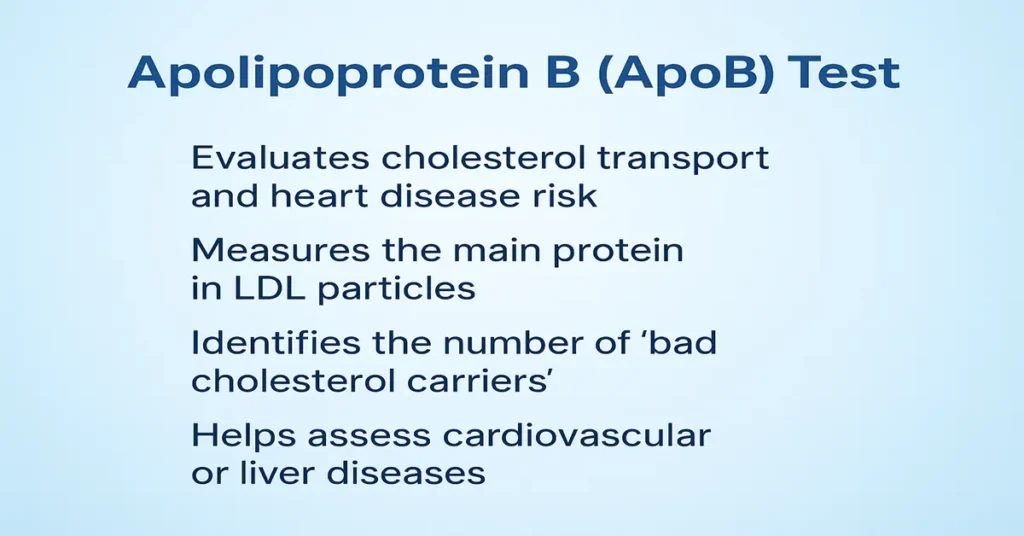
The Apolipoprotein B (ApoB) test is a blood test used to evaluate how cholesterol is being transported in the body and to estimate the risk of cardiovascular disease. ApoB is the main structural protein found on lipoproteins that carry cholesterol and triglycerides in the blood—most notably LDL (low-density lipoprotein), VLDL (very-low-density lipoprotein), and IDL (intermediate-density lipoprotein). These particles are often described as “atherogenic” because they can deposit cholesterol into the walls of arteries.
From a laboratory and clinical standpoint, ApoB is especially useful because each LDL particle contains exactly one ApoB molecule. This means the ApoB level reflects the actual number of cholesterol-carrying particles in circulation, not just how much cholesterol they contain. For this reason, ApoB is often considered a more precise marker of cardiovascular risk than LDL cholesterol alone.
What is Apolipoprotein B (ApoB)?
Apolipoprotein B is a protein that forms the backbone of several lipoproteins responsible for transporting fats and cholesterol through the bloodstream. Without ApoB, these particles cannot be assembled or remain stable in circulation.
There are two main forms of ApoB in humans:
- ApoB-100, produced in the liver, which is present in LDL, VLDL, and IDL and carries cholesterol from the liver to body tissues.
- ApoB-48, produced in the small intestine, which is found in chylomicrons and is involved in transporting dietary fats after meals.
Together, these forms play an essential role in normal lipid metabolism and energy distribution.
Where is ApoB Produced in the Body?
ApoB is produced in two key sites:
- Liver: synthesizes ApoB-100, which becomes part of LDL, VLDL, and IDL particles.
- Small intestine: produces ApoB-48, which is incorporated into chylomicrons that transport dietary fats.
Once formed, ApoB combines with lipids to create lipoprotein particles that circulate throughout the bloodstream and deliver fats to various tissues.
Main Functions and Importance of ApoB
ApoB has several clinically important roles:
Cholesterol and fat transport:
ApoB allows cholesterol and triglycerides to be packaged and delivered from the liver and intestine to tissues that require them.
Structural stability:
It provides the structural framework for LDL, VLDL, IDL, and chylomicrons. Without ApoB, these particles cannot exist.
Indicator of cardiovascular risk:
Because each LDL particle carries one ApoB molecule, a higher ApoB level signals a higher number of cholesterol-rich particles capable of entering artery walls and contributing to plaque formation.
Risk assessment tool:
In many patients, ApoB offers a clearer picture of cardiovascular risk than LDL cholesterol, especially when cholesterol content and particle number do not match.
Causes of Low ApoB Levels
Low ApoB levels are relatively uncommon and usually reflect reduced production or absorption of ApoB-containing lipoproteins. Clinically, they may be seen in situations such as severe nutritional deficiency, certain inherited lipid disorders, advanced liver disease, or conditions where lipid production is suppressed. Some medications that affect lipid metabolism can also lower ApoB levels.
Symptoms of Low ApoB Levels
Low ApoB itself does not usually cause symptoms. When symptoms are present, they are typically related to the underlying condition rather than the ApoB value alone. In rare inherited disorders, patients may show signs of fat malabsorption or deficiencies of fat-soluble vitamins, which then lead to broader systemic effects.
Causes of High ApoB Levels
High ApoB levels are common and clinically significant. They indicate an increased number of atherogenic lipoprotein particles in the blood. This pattern is frequently seen in metabolic conditions such as diabetes, insulin resistance, obesity, and genetic lipid disorders, as well as in people with reduced thyroid function or chronic kidney disease. Lifestyle factors such as smoking and long-term physical inactivity are often associated as well.
Symptoms of High ApoB Levels
Elevated ApoB does not cause symptoms by itself. Instead, it signals increased long-term risk for conditions such as atherosclerosis, coronary artery disease, stroke, and peripheral artery disease. Because these complications develop silently over years, ApoB testing is valuable as an early warning marker.
Reference Ranges (Normal Values)
ApoB is usually reported in mg/dL. Typical interpretation is:
- Below ~90 mg/dL: generally considered optimal
- Around 90–109 mg/dL: borderline range
- 110 mg/dL and above: associated with higher cardiovascular risk
Exact cut-offs may vary slightly depending on the laboratory and clinical guidelines used.
Sample Type and Collection
The test is performed on a blood sample, collected as serum or plasma from a vein in the arm. ApoB testing is often done alongside a lipid profile.
Test Preparation
Fasting for several hours is commonly recommended, particularly if other lipid tests are being performed at the same time. Patients should inform their doctor about current medications, especially those affecting cholesterol or thyroid function, as these can influence results.
When to Consult a Doctor
An ApoB test is often useful for people with a family history of early heart disease, abnormal cholesterol levels, diabetes, obesity, or unexplained cardiovascular risk. It may also be ordered when standard lipid results do not fully explain a patient’s risk profile.
Doctors interpret ApoB alongside other laboratory results and clinical findings to decide whether further evaluation or monitoring is needed.
Important Word Explanations
- Lipoprotein: A particle made of fat and protein that transports lipids in the blood.
- LDL: A cholesterol-carrying lipoprotein associated with plaque formation in arteries.
- Atherosclerosis: Narrowing and hardening of arteries due to cholesterol buildup.
- Triglycerides: A form of fat used by the body for energy storage.
- Familial hypercholesterolemia: An inherited disorder causing high cholesterol and increased cardiovascular risk.
- Chylomicrons: Lipoproteins that transport dietary fats from the intestine into the bloodstream.
~END~
Related Posts
None found