
Overview
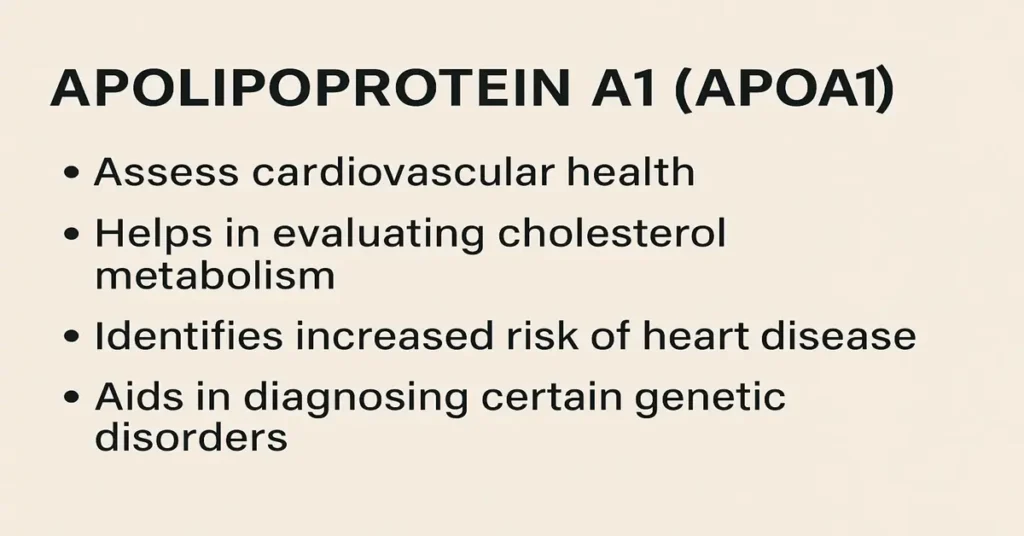
Apolipoprotein A1 (ApoA1) is the main protein component of high-density lipoprotein (HDL), often referred to as the “good cholesterol.” From a laboratory perspective, ApoA1 is central to how the body handles cholesterol safely. It helps remove excess cholesterol from the bloodstream and vessel walls and transports it back to the liver for processing and elimination. This protective role is why ApoA1 is closely linked to cardiovascular health.
Measuring ApoA1 in blood gives clinicians additional insight beyond a routine lipid profile. It helps assess cardiovascular risk, provides clues about liver function, and reflects how efficiently the body manages lipid metabolism overall.
What is ApoA1?
Apolipoprotein A1 is a protein that binds with fats to form HDL particles. These particles act as scavengers, collecting excess cholesterol from tissues and blood vessels and carrying it back to the liver. Because of this role, ApoA1 is generally associated with protection against conditions such as coronary artery disease and stroke.
From a biochemical standpoint, ApoA1 also activates an important enzyme called LCAT (lecithin-cholesterol acyltransferase). This enzyme converts free cholesterol into a form that can be safely packaged within HDL. In simple terms, ApoA1 helps cholesterol move through the bloodstream in a controlled and non-harmful way.
Where is ApoA1 Produced in the Body?
ApoA1 is produced mainly in the liver and, to a lesser extent, in the small intestine. Once synthesized, it enters the circulation as part of newly formed HDL particles.
These HDL particles continuously circulate through the bloodstream, picking up cholesterol from peripheral tissues, including the inner walls of arteries. The cholesterol is then transported back to the liver. Clinically, this process—known as reverse cholesterol transport—is one of the body’s most important natural defenses against cholesterol buildup.
Main Functions and Importance of ApoA1
ApoA1 has several interconnected roles that explain why it is considered protective:
Cholesterol handling:
By activating LCAT, ApoA1 allows free cholesterol to be converted into a stable form that can be carried within HDL particles.
Reverse cholesterol transport:
ApoA1-containing HDL removes excess cholesterol from tissues and arteries and delivers it back to the liver. This limits plaque formation over time.
Vessel protection:
ApoA1 contributes to maintaining healthy blood vessel linings by reducing oxidative stress and inflammation, processes that otherwise damage arteries.
Cardiovascular risk assessment:
Higher ApoA1 levels generally reflect efficient HDL function and are associated with lower cardiovascular risk. For this reason, ApoA1 is often interpreted alongside ApoB to give a more balanced view of lipid-related risk.
Causes of Low ApoA1 Levels
Low ApoA1 levels suggest reduced HDL activity or altered lipid metabolism. In practice, this finding prompts clinicians to look for underlying contributors rather than symptoms from the protein itself.
Common clinical associations include liver disorders, since ApoA1 is produced in the liver, as well as inherited conditions affecting lipoprotein metabolism. Chronic inflammatory states, metabolic conditions such as diabetes, and long-standing nutritional issues can also be associated with lower levels. Lifestyle factors, particularly smoking and prolonged inactivity, may contribute as well.
Symptoms of Low ApoA1
Low ApoA1 levels do not cause symptoms on their own. Instead, they act as a laboratory signal pointing toward increased cardiovascular risk.
In more pronounced or inherited deficiencies, patients may have a history of early cardiovascular disease or persistently low HDL levels on routine testing. From a clinician’s point of view, the value lies in risk identification rather than symptom explanation.
Causes of High ApoA1 Levels
Higher ApoA1 levels are usually interpreted as favorable. They reflect efficient HDL formation and cholesterol transport.
Such results are often seen in individuals with good lipid balance or in those whose HDL metabolism is enhanced, whether naturally or through medical management. In routine practice, elevated ApoA1 is rarely a cause for concern and typically does not require further investigation by itself.
Symptoms of High ApoA1
High ApoA1 levels do not produce symptoms and are not associated with harmful effects. In fact, they are commonly viewed as a reassuring laboratory finding in the context of cardiovascular assessment.
Reference Ranges
Reference ranges may vary slightly between laboratories, but commonly used values are:
- Men: approximately 1.04 – 2.03 g/L (104 – 203 mg/dL)
- Women: approximately 1.12 – 2.21 g/L (112 – 221 mg/dL)
Women often have slightly higher levels, which is thought to reflect hormonal influences on HDL metabolism.
Sample Type and Test Procedure
Sample type:
A blood sample is collected as serum or plasma, usually from a vein in the arm.
Test procedure:
In the laboratory, ApoA1 is measured using immunoturbidimetric or nephelometric techniques. These methods allow precise and reproducible quantification of the protein.
Test Preparation
Fasting is usually not required for an isolated ApoA1 test. However, if it is ordered alongside a full lipid profile, fasting may be advised.
Patients should inform their doctor about any lipid-lowering medications or hormone therapy, as these can influence results. Avoiding alcohol and smoking just before testing may help reduce short-term variability.
When to Consult a Doctor
An ApoA1 test is often discussed when there is concern about cardiovascular risk or unexplained lipid abnormalities. It may be useful if there is a family history of early heart disease, persistently low HDL levels, known liver or metabolic conditions, or abnormal results on standard cholesterol testing.
If ApoA1 is low, doctors usually interpret it in combination with other lipid parameters and clinical factors to decide whether further evaluation is needed.
Important Word Explanations
- HDL (High-Density Lipoprotein): Lipoprotein that helps remove excess cholesterol from the bloodstream.
- LDL (Low-Density Lipoprotein): Lipoprotein that carries cholesterol to tissues and can accumulate in arteries.
- Atherosclerosis: Gradual narrowing and hardening of arteries due to plaque buildup.
- LCAT: An enzyme activated by ApoA1 that converts free cholesterol into a transportable form.
- Xanthomas: Fatty deposits under the skin seen in some lipid disorders.
- Tangier disease: A rare inherited condition associated with extremely low HDL and ApoA1 levels.
~END~
Related Posts
None found