
Overview
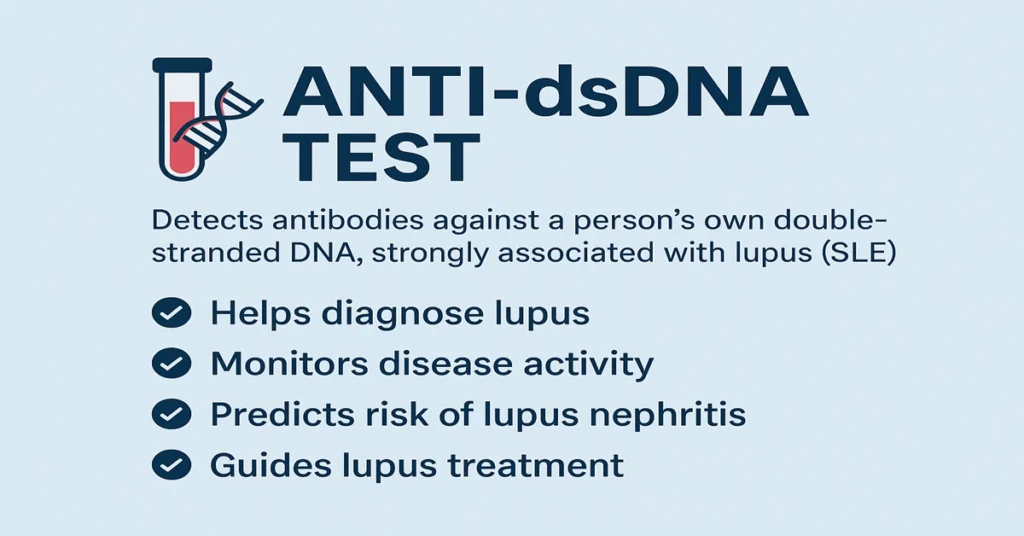
The Anti-dsDNA Test is a blood test that detects antibodies directed against the body’s own double-stranded DNA (dsDNA). These antibodies are called autoantibodies because they arise when the immune system mistakenly reacts against normal body components. Anti-dsDNA antibodies are most closely associated with Systemic Lupus Erythematosus (SLE), an autoimmune condition that can involve the skin, joints, blood, and internal organs, particularly the kidneys.
From a clinical standpoint, this test is valuable because it is relatively specific for lupus. When present in significant amounts, it strongly supports the diagnosis and also helps doctors judge how active the disease may be at a given time. It is commonly used both at diagnosis and during follow-up, especially when kidney involvement is a concern.
What Is the Anti-dsDNA Test?
The Anti-dsDNA Test measures the level of antibodies that target double-stranded DNA, a normal component found inside the nucleus of every cell. These antibodies are not expected in healthy individuals and usually appear when immune regulation is disturbed.
Doctors request this test to support the diagnosis of systemic lupus erythematosus, to monitor changes in disease activity, and to look for signs that organs—most notably the kidneys—may be affected. Because antibody levels often change with disease activity, the test can provide useful context when symptoms fluctuate or when other laboratory markers shift.
Where Are Anti-dsDNA Antibodies Produced in the Body?
Anti-dsDNA antibodies are produced by the immune system itself.
They originate mainly from B-lymphocytes that have transformed into plasma cells. Under normal conditions, these cells create antibodies to fight infections. In autoimmune states such as lupus, immune tolerance is lost, and these cells begin producing antibodies against the body’s own DNA.
Once formed, anti-dsDNA antibodies circulate in the bloodstream and can deposit in tissues. The kidneys are particularly vulnerable, which explains the close association between rising antibody levels and lupus-related kidney inflammation.
Main Functions and Importance of Anti-dsDNA Test
The antibodies themselves are harmful, but detecting them has important clinical value.
One of the main strengths of this test is its specificity. Anti-dsDNA antibodies are uncommon outside lupus, so a positive result carries significant diagnostic weight. Beyond diagnosis, doctors also use the test to monitor disease activity. Rising levels often parallel increased immune activity, while falling levels may be seen when the disease is quieter.
Another key role of the test is in assessing kidney risk. In many patients, higher antibody levels are seen alongside kidney inflammation, making the test helpful when evaluating or monitoring lupus nephritis. Finally, anti-dsDNA results assist in distinguishing lupus from other autoimmune conditions that may present with overlapping symptoms.
Causes of Low / Negative Anti-dsDNA Levels
A low or negative result means that anti-dsDNA antibodies are absent or present only in very small amounts.
This is typically seen in healthy individuals and in people who do not have lupus. It may also occur in patients with lupus whose disease is inactive or well controlled. In early or mild forms of lupus, antibodies may not yet be detectable. Other autoimmune disorders that do not involve dsDNA antibodies can also show negative results.
Symptoms of Low / Negative Levels
Low or negative antibody levels usually indicate minimal or absent immune activity against dsDNA.
In practical terms, this often aligns with stable disease, remission, or the absence of lupus altogether. There are no specific symptoms caused by a negative test result itself, and patients generally do not experience lupus-related organ involvement linked to dsDNA antibodies at that time.
Causes of High / Positive Anti-dsDNA Levels
Elevated anti-dsDNA levels are most commonly associated with active systemic lupus erythematosus.
They are frequently seen when the disease is more active and are especially associated with kidney involvement. In rare cases, low-level positivity may be observed in other autoimmune conditions or in drug-induced lupus-like states, but these situations are far less common. In routine practice, a clearly positive result strongly points toward lupus-related immune activity.
Symptoms of High / Positive Levels
When anti-dsDNA levels are high, symptoms usually reflect increased lupus activity rather than the antibody level alone.
Patients may experience general symptoms such as fatigue, fever, or a sense of being unwell. Joint pain, swelling, and stiffness are common, along with skin changes such as rashes or sensitivity to sunlight. Kidney involvement may show up as swelling in the legs, changes in urine appearance, or rising blood pressure. These features prompt closer medical evaluation, as they suggest active organ involvement.
Reference Ranges
Reference ranges vary depending on the laboratory and testing method, but results are often reported in categories such as negative, equivocal, or positive.
Doctors interpret these values together with other findings, including ANA testing, complement levels, inflammatory markers, urine studies, and—most importantly—clinical symptoms. The number alone is not used to make decisions without this broader context.
Sample Type
The test requires a blood sample, usually serum, collected from a vein in the arm. Fasting is not required, and the procedure is the same as for most routine blood tests.
Test Preparation
No special preparation is usually needed before testing. Patients are advised to inform their doctor about ongoing symptoms, known autoimmune conditions, kidney issues, and current medications. Testing is ideally done when there is no acute infection, as intercurrent illnesses can sometimes influence immune markers.
When to Consult a Doctor
Medical advice should be sought if symptoms suggestive of lupus develop, such as persistent fatigue, joint pain, skin rashes, or sensitivity to sunlight. Changes in urination, swelling of the legs, or rising blood pressure warrant prompt evaluation, especially in people already diagnosed with lupus.
For those with known SLE, worsening symptoms or new organ-related complaints may signal increased disease activity and justify repeat testing. Sudden or severe symptoms—particularly those related to kidney function or blood pressure—require urgent medical attention.
Important Word Explanations
- Autoantibodies: Antibodies that mistakenly target the body’s own tissues.
- B-lymphocytes: Immune cells responsible for producing antibodies.
- Systemic Lupus Erythematosus (SLE): An autoimmune disease that can affect multiple organs.
- Lupus nephritis: Kidney inflammation caused by lupus-related immune activity.
- ANA test: A general screening test for autoimmune disorders.
- Complement levels: Immune proteins that often decrease during active lupus.
~END~
Related Posts
None found