
Overview
The Anti-dsDNA Antibody Test is a blood test used to detect antibodies directed against double-stranded DNA (dsDNA), which is the genetic material present inside our own cells. These antibodies are known as autoantibodies because they react against the body’s own structures rather than against infections.
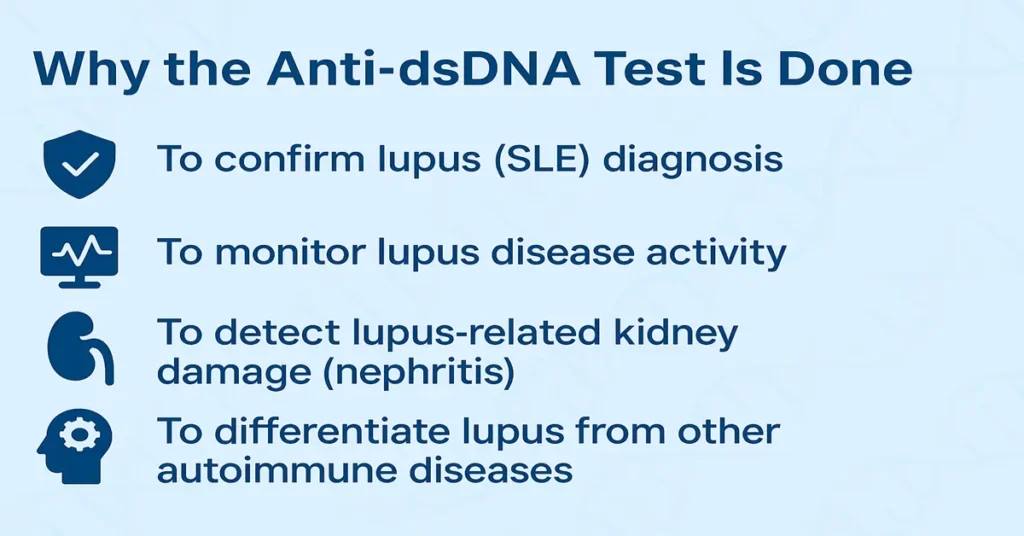
In clinical practice, this test is closely linked with Systemic Lupus Erythematosus (SLE). It is one of the most specific laboratory markers for lupus and is commonly used not only to support diagnosis but also to assess disease activity over time. Doctors often rely on this test when monitoring lupus, particularly when there is concern about kidney involvement, known as lupus nephritis.
What Is the Anti-dsDNA Antibody Test?
The Anti-dsDNA (Anti–Double-Stranded DNA) Test measures autoantibodies that target double-stranded DNA within the body. Under normal conditions, the immune system does not react to DNA. In autoimmune diseases such as lupus, however, immune tolerance is lost, and antibodies are produced against nuclear components.
Anti-dsDNA antibodies belong to the broader group of antinuclear antibodies (ANA). Because they are rarely seen outside of lupus, their presence provides strong supportive evidence for SLE. For this reason, the test is usually ordered after an ANA test has already shown a positive result.
Where Are Anti-dsDNA Antibodies Produced?
These antibodies are produced by B lymphocytes, the immune cells responsible for antibody formation. In lupus, these cells become abnormally activated and begin reacting to the body’s own DNA, particularly DNA released from damaged or dying cells.
Production mainly occurs within immune-active tissues such as the lymph nodes, spleen, and bone marrow. Once released into the bloodstream, Anti-dsDNA antibodies can combine with DNA to form immune complexes, which may deposit in organs—most notably the kidneys—leading to inflammation.
Main Functions and Clinical Importance
Anti-dsDNA antibodies have no physiological role in a healthy immune system. Their importance lies entirely in their diagnostic and monitoring value.
From a clinical perspective, Anti-dsDNA antibodies are among the most specific laboratory markers for SLE. A positive result strongly supports a lupus diagnosis when interpreted alongside symptoms and other investigations. In patients already diagnosed with lupus, changes in antibody levels often parallel disease activity, making the test useful for ongoing assessment.
Elevated levels may also act as a clinical signal for organ involvement, particularly kidney inflammation, and help distinguish lupus from other autoimmune conditions where these antibodies are uncommon.
Causes of Low or Negative Levels
Low or negative Anti-dsDNA levels generally indicate that antibodies against DNA are not currently detectable. This may suggest absence of lupus, inactive disease, or a phase where antibody levels are suppressed.
Such results can also be seen in early disease before antibodies have fully developed, or during periods when lupus is clinically quiet. A negative result reduces the likelihood of active lupus but does not entirely exclude the diagnosis in all cases.
Symptoms of Low Levels
Low or negative Anti-dsDNA levels do not cause symptoms on their own. If symptoms suggestive of lupus are present despite a negative result, doctors usually rely on additional clinical findings and complementary tests for assessment.
Causes of High Anti-dsDNA Levels
Raised Anti-dsDNA antibody levels are most commonly associated with Systemic Lupus Erythematosus. While they may occasionally appear in other autoimmune or chronic inflammatory conditions, this is uncommon.
In lupus, higher levels are often seen during periods of increased disease activity. For this reason, doctors pay close attention to rising values, particularly when evaluating possible organ involvement.
Symptoms of High Levels
Anti-dsDNA antibodies themselves do not produce symptoms. Any symptoms reflect the underlying autoimmune activity of lupus rather than the antibody alone.
When levels are elevated, patients may experience joint discomfort, fatigue, skin changes, or other features typical of active lupus. Kidney involvement may present with swelling, changes in urine appearance, or blood pressure changes. The antibody result helps clinicians link these clinical features to immune activity.
Reference Ranges
Reference ranges for Anti-dsDNA antibodies vary depending on the laboratory method used. Results are commonly reported as negative, borderline, or positive, sometimes with numerical values.
Lower or negative values are generally considered normal. Borderline results may require follow-up testing, while clearly positive values increase suspicion for lupus, especially when supported by symptoms and other laboratory markers. Interpretation is always done in clinical context.
Sample Type and Test Method
The Anti-dsDNA test is performed on a serum blood sample, typically collected in a plain or serum separator tube. Fasting is not required.
Several laboratory methods are used, including ELISA, Crithidia luciliae immunofluorescence, and Farr assay. Each method has different sensitivity and specificity, and the choice depends on clinical needs and laboratory practice.
Test Preparation
No special preparation is usually needed. Patients should inform their doctor about current medications, particularly immunosuppressive drugs or steroids, as these may influence antibody levels.
In people with known lupus, the test may be repeated periodically to observe trends rather than relying on a single value.
When to Consult a Doctor
Medical consultation is advised if symptoms such as persistent joint pain, unexplained fatigue, skin rashes that worsen with sunlight, swelling of the legs or face, or changes in urine are present.
Doctors may order the Anti-dsDNA test when lupus is suspected or when monitoring known disease. Results are typically interpreted alongside ANA testing, complement levels, urine analysis, and clinical examination.
Important Word Explanations
- Anti-dsDNA Antibody: An autoantibody directed against double-stranded DNA, strongly associated with lupus.
- Autoantibody: An antibody that reacts against the body’s own tissues.
- Systemic Lupus Erythematosus (SLE): A chronic autoimmune disease affecting multiple organs.
- Lupus Nephritis: Kidney inflammation caused by lupus-related immune activity.
- B Lymphocytes: Immune cells that produce antibodies.
- Flare-up: A period of increased disease activity.
- ANA (Antinuclear Antibody): A screening test that detects antibodies against nuclear components of cells.
~END~
Related Posts
None found