
Overview
The Anti-CCP Antibody Test (Anti–Cyclic Citrullinated Peptide Antibody Test) is a blood test used to detect antibodies directed against cyclic citrullinated peptides. These peptides are formed when certain proteins in the body undergo a natural chemical change known as citrullination. In some individuals, this change can trigger an abnormal immune response.
In clinical practice, the Anti-CCP test is most closely associated with Rheumatoid Arthritis (RA), a chronic autoimmune condition that affects the joints. Anti-CCP antibodies are considered highly specific for RA and, importantly, they may be present long before joint symptoms become obvious. For this reason, the test plays a valuable role in early evaluation and diagnostic planning.
What Is the Anti-CCP Antibody Test?
The Anti-CCP test looks for autoantibodies—antibodies produced by the immune system that mistakenly target the body’s own tissues—against citrullinated proteins. Under normal circumstances, antibodies are formed to defend against infections. In autoimmune conditions, however, this protective system becomes misdirected.
Anti-CCP antibodies are directed toward citrullinated proteins that are commonly found in joint tissues. Their detection provides strong evidence of an autoimmune process consistent with Rheumatoid Arthritis and is considered more specific for RA than some older antibody tests.
Where Is It Produced in the Body?
Anti-CCP antibodies are produced by B lymphocytes, which are immune cells responsible for antibody formation. In individuals with or at risk of Rheumatoid Arthritis, these cells become activated against citrullinated proteins.
This immune activity is most closely linked to areas such as the synovial tissue lining the joints, nearby lymph nodes, and the bone marrow. These sites can act as focal points for immune activation in autoimmune joint disease.
Main Functions and Clinical Importance
Anti-CCP antibodies do not have a normal or beneficial function. Their importance lies in what they indicate about immune system activity.
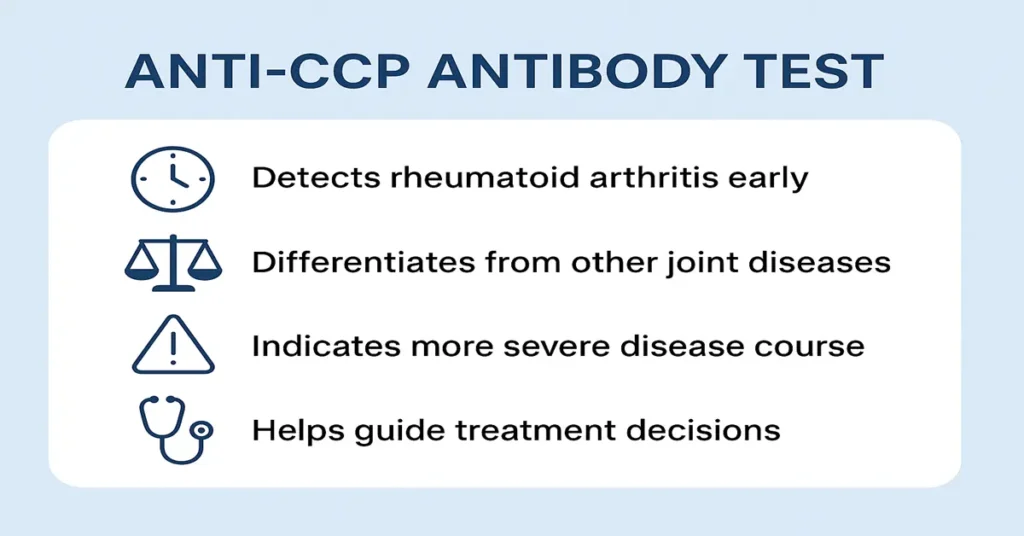
Clinically, Anti-CCP testing is valuable because it helps identify Rheumatoid Arthritis at an early stage and distinguishes it from other causes of joint pain and inflammation. Compared with some other markers, Anti-CCP antibodies are rarely seen outside RA, which increases their diagnostic reliability.
Doctors also consider Anti-CCP results when assessing the likely course of the disease, as higher antibody levels are often associated with a more active or progressive pattern.
Causes of Low or Negative Levels
Low or negative Anti-CCP levels suggest that antibodies against citrullinated proteins are not detectable. This may indicate the absence of an active autoimmune response involving these targets.
Such results can be seen in healthy individuals, in very early stages of disease before antibodies develop, or in people whose autoimmune condition is inactive or well controlled. A negative result does not completely exclude Rheumatoid Arthritis, especially if symptoms are present.
Symptoms of Low Levels
Low or negative Anti-CCP levels do not cause symptoms. When symptoms such as joint pain or stiffness exist despite a negative test, clinicians may consider other causes or additional investigations, including imaging and alternative laboratory markers.
Causes of High Levels
Elevated Anti-CCP antibody levels most commonly reflect an autoimmune reaction consistent with Rheumatoid Arthritis. In a small number of cases, these antibodies may also be detected in other autoimmune or inflammatory conditions, but this is uncommon.
A positive Anti-CCP result is therefore considered a strong clinical signal, particularly when joint-related symptoms are present.
Symptoms of High Levels
Anti-CCP antibodies themselves do not directly cause symptoms. Symptoms arise from the underlying autoimmune inflammation affecting the joints.
Individuals with elevated Anti-CCP levels often experience joint pain, stiffness—especially in the morning—swelling, and reduced joint function. Fatigue and general discomfort may also be present. The pattern and progression of symptoms depend on disease activity and duration rather than antibody levels alone.
Reference Ranges
Anti-CCP results are reported in units defined by the laboratory method used. Values below the laboratory cutoff are considered negative, while higher values are classified as positive at varying strengths.
Stronger positive results increase the likelihood of Rheumatoid Arthritis, particularly when clinical features and imaging findings are supportive. As with all antibody tests, results must be interpreted in the context of symptoms and other investigations.
Sample Type and Test Method
The Anti-CCP test is performed on a blood sample, usually collected as serum in a plain or serum separator tube. Fasting is not required.
Most laboratories use enzyme-linked immunosorbent assay (ELISA) techniques to measure Anti-CCP antibody concentrations accurately and reliably.
Test Preparation
No special preparation is usually necessary before Anti-CCP testing. Patients should inform their doctor about current medications, particularly those that affect the immune system, as this information can help with interpretation.
Providing details about joint symptoms, their duration, and pattern also assists clinicians in placing the test result in proper clinical context.
When to Consult a Doctor
Medical advice is recommended if there is persistent joint pain, swelling, or stiffness, especially when symptoms are symmetrical or worse in the morning. Unexplained fatigue, low-grade fever, or a family history of autoimmune disease may also prompt evaluation.
If Anti-CCP antibodies are detected, doctors often consider additional tests and imaging studies to confirm the diagnosis and assess joint involvement.
Important Word Explanations
- Antibody: A protein produced by the immune system to recognize and bind foreign substances.
- Autoantibody: An antibody that mistakenly targets the body’s own tissues.
- Citrullination: A natural chemical modification of proteins that can trigger immune reactions in certain diseases.
- Rheumatoid Arthritis (RA): A chronic autoimmune condition characterized by inflammation of the joints.
- B Lymphocytes: Immune cells responsible for producing antibodies.
- Synovial Tissue: The lining of joints where inflammation commonly occurs in Rheumatoid Arthritis.
- ELISA: A laboratory method used to measure antibodies or other substances in the blood.
~END~
Related Posts
None found
Wow, that’s what I was seeking for, what a stuff!
existing here at this web site, thanks admin of this site.