
Overview
The ANA Test (Antinuclear Antibody Test) is a blood test used to detect antinuclear antibodies (ANA) in the bloodstream. These antibodies belong to a group known as autoantibodies, meaning they are produced when the immune system reacts against the body’s own cells rather than against infections. In this case, the target is the cell nucleus, which contains genetic material and controls normal cell function.
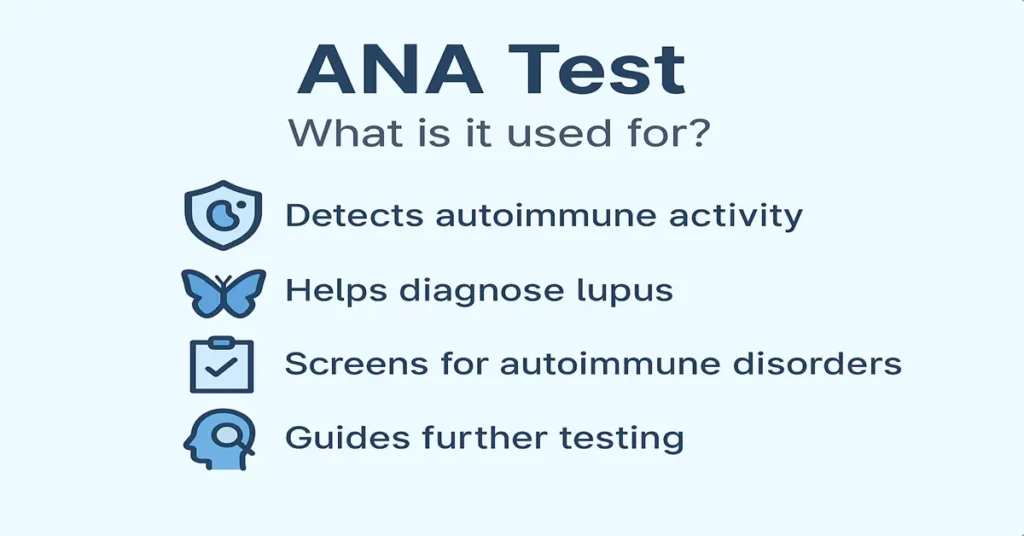
In routine clinical practice, the ANA test is widely used as an initial screening tool when an autoimmune or connective tissue disorder is suspected. A positive result does not confirm a diagnosis on its own, but it helps doctors decide whether further, more specific testing is needed.
The test is commonly used as part of the evaluation for conditions such as Systemic Lupus Erythematosus (SLE), Sjögren’s syndrome, scleroderma, mixed connective tissue disease, and, in some cases, rheumatoid arthritis.
What is ANA (Antinuclear Antibody)?
ANA stands for Antinuclear Antibody, referring to antibodies that react with components inside the nucleus of human cells. Under normal circumstances, the immune system distinguishes clearly between the body’s own tissues and foreign organisms.
In autoimmune conditions, this distinction becomes blurred. The immune system produces antibodies that recognize and bind to normal cellular structures, leading to inflammation and tissue damage. The ANA test helps identify whether this type of immune activity may be occurring, serving as an important signal rather than a definitive answer.
Where is ANA Produced in the Body?
Antinuclear antibodies are produced by B lymphocytes, a type of white blood cell involved in immune defense. These cells are mainly located in the bone marrow, lymph nodes, and spleen.
In autoimmune disorders, B-cells become abnormally activated and begin producing antibodies against the body’s own nuclear material. This abnormal antibody production is a common feature across many autoimmune and connective tissue diseases, which is why ANA testing has broad clinical relevance.
Main Functions and Importance
ANA itself has no protective or beneficial role. Its importance lies entirely in what its presence suggests about immune system behavior.
From a clinical perspective, ANA testing is used to screen for autoimmune diseases and to support diagnostic reasoning when patients present with symptoms such as joint pain, rashes, or unexplained fatigue. A positive ANA result often guides doctors toward more specific antibody tests, which help narrow down the exact condition involved.
In patients with known autoimmune disease, ANA testing may also be used alongside other markers to observe general disease patterns over time, though it is rarely interpreted in isolation.
Causes of Low or Negative ANA Levels
A negative ANA result means that antinuclear antibodies are not detected in the blood, which is the expected finding in most healthy individuals.
Low or negative ANA levels may also be seen in the early stages of some autoimmune conditions, before antibody production becomes detectable, or in diseases where ANA is not a prominent feature. Certain medications that suppress the immune system can also reduce detectable antibody levels. For this reason, a negative ANA does not always completely exclude autoimmune disease.
Symptoms of Low/Negative ANA Levels
Low or negative ANA levels do not cause symptoms. The test result simply reflects the absence of detectable antinuclear antibodies.
If symptoms suggestive of autoimmune disease are present despite a negative ANA test, clinicians may still pursue additional investigations based on the overall clinical picture.
Causes of High or Positive ANA Levels
A positive ANA test indicates the presence of antinuclear antibodies in the bloodstream. In clinical practice, this finding often raises suspicion of an autoimmune disorder, particularly when symptoms are present.
Higher ANA levels are commonly associated with conditions such as systemic lupus erythematosus, Sjögren’s syndrome, scleroderma, and mixed connective tissue disease. Positive results can also be seen in other autoimmune conditions, and occasionally in people without any apparent disease, especially at lower titers. This variability is why ANA results are always interpreted cautiously and in context.
Symptoms of High ANA Levels
ANA itself does not cause symptoms. Any symptoms experienced are due to the underlying autoimmune condition rather than the antibody level alone.
Patients may report fatigue, joint pain or stiffness, skin changes, dryness of eyes or mouth, or sensitivity to sunlight, depending on the specific disease involved. When a positive ANA result is combined with characteristic symptoms, doctors usually proceed with targeted antibody testing to clarify the diagnosis.
Reference Ranges (Titer Values)
ANA results are reported as titers, which reflect how strongly antibodies are detected when the blood sample is diluted. Lower titers are often considered negative or borderline, while higher titers increase the likelihood of autoimmune disease.
In general, stronger titers are more clinically significant, but there is no single cutoff that applies to all patients. Interpretation depends on the titer level, the fluorescence pattern, and the individual’s symptoms. The reference range provided by the laboratory should always be used for comparison.
Sample Type
The ANA test is performed on a blood sample, usually collected as serum in a plain or serum separator tube. Fasting is not required.
Most laboratories use indirect immunofluorescence assay (IFA) or, in some settings, ELISA-based methods. The fluorescence pattern observed under the microscope can provide additional clues about the type of autoimmune condition being considered.
Why the ANA Test is Important
The ANA test serves as a first-line screening investigation when autoimmune disease is suspected. It helps clinicians distinguish between autoimmune and non-autoimmune causes of symptoms such as joint pain, rashes, or chronic fatigue.
A positive ANA result often directs further testing toward specific autoantibodies, allowing for a more precise diagnosis. In patients with established autoimmune disease, ANA testing may also contribute to long-term clinical assessment when interpreted alongside other findings.
Test Preparation
No special preparation is usually required for an ANA test. Fasting is not necessary, and the test can be done at any time of day.
Patients are advised to inform their doctor about any medications they are taking, particularly immunosuppressive drugs or steroids, as these may influence antibody levels.
When to Consult a Doctor
Medical advice should be sought if symptoms such as persistent fatigue, joint pain, unexplained rashes, mouth ulcers, hair loss, or sensitivity to sunlight are present. Dry eyes, dry mouth, or color changes in fingers in response to cold may also prompt evaluation.
If there is a family history of autoimmune disease or ongoing unexplained symptoms, a healthcare professional may recommend ANA testing as part of a broader diagnostic approach.
Important Word Explanations
- Autoantibody: An antibody produced by the immune system that targets the body’s own tissues.
- Nucleus: The central structure of a cell that contains genetic material (DNA).
- Titer: A laboratory measurement indicating the relative concentration of an antibody in the blood.
- Autoimmune disease: A condition in which the immune system mistakenly attacks healthy cells.
- Raynaud’s Phenomenon: A condition where fingers or toes change color in response to cold or stress due to reduced blood flow.
~END~
Related Posts
None found