
Overview
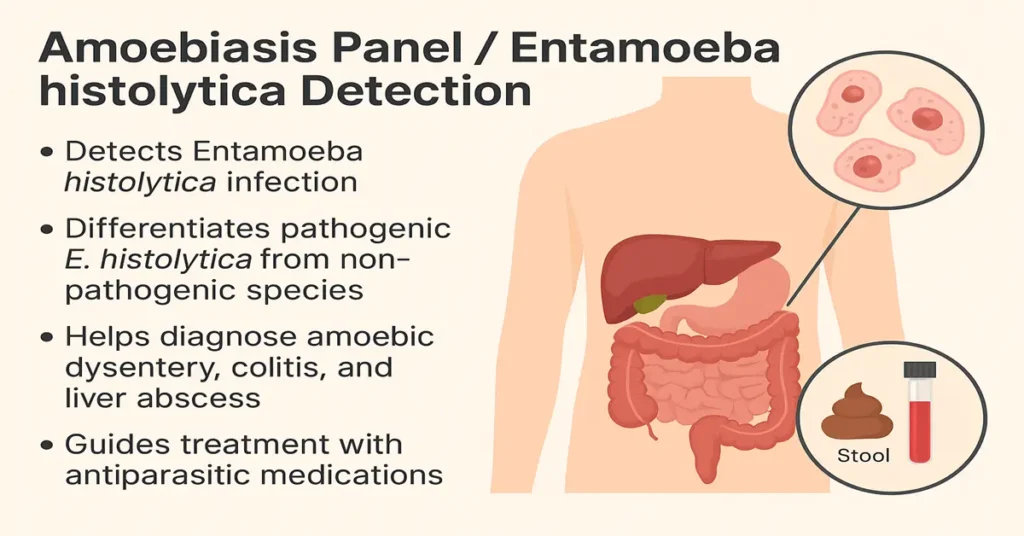
The Amoebiasis Panel is a group of laboratory tests used to detect infection caused by Entamoeba histolytica, a parasitic protozoan responsible for amoebiasis. This infection primarily affects the large intestine, where it can cause inflammation and ulceration. In some patients, especially when diagnosis is delayed, the parasite may spread through the bloodstream and involve the liver, leading to an amoebic liver abscess.
In routine clinical practice, this panel is requested when symptoms such as persistent diarrhea, abdominal pain, blood or mucus in stools, or unexplained liver lesions are present. Imaging findings often raise suspicion first, and laboratory testing then helps confirm whether the cause is parasitic. The panel supports diagnosis, clarifies disease severity, and helps doctors plan further evaluation and monitoring.
What is Entamoeba histolytica?
Entamoeba histolytica is a microscopic parasite that enters the human body through contaminated food, water, or poor hygiene practices. Humans become infected accidentally by ingesting the infective form of the parasite.
Inside the body, the parasite exists in two main forms. The cyst form is the hardy, infective stage that survives in the environment and allows transmission. Once inside the intestine, cysts release trophozoites, the active form that can invade the intestinal lining and cause tissue damage. In some cases, these trophozoites spread beyond the intestine, most commonly to the liver.
Where is it Produced in the Body?
This parasite is not produced by the human body. It enters from outside through ingestion of contaminated material. After entry, it settles in the large intestine, where it may remain confined or invade surrounding tissue. If it reaches the bloodstream, it can travel to other organs, particularly the liver, where it may form abscesses.
Why is the Amoebiasis Panel Important?
The Amoebiasis Panel plays a key role in evaluating suspected parasitic intestinal and liver infections. It helps confirm whether Entamoeba histolytica is present and distinguishes it from non-pathogenic amoebae that do not cause disease. This distinction is clinically important because harmless species can appear similar under routine microscopy.
The panel also supports the diagnosis of more serious presentations such as amoebic colitis and amoebic liver abscess. In addition, test results help clinicians monitor disease progression and response to therapy, reducing the risk of complications associated with delayed or missed diagnosis.
Causes of Low / Negative Results
A negative result most commonly indicates the absence of amoebic infection. However, it may also occur when testing is done very early, before parasite levels become detectable, or when the parasite load is low. Patients who have already started antiparasitic medication may also show reduced detection on testing.
In some cases, symptoms may be caused by other intestinal infections or non-infectious bowel conditions, which explains a negative amoebiasis panel despite ongoing complaints.
Symptoms When Results Are Negative But Infection Exists
The test result itself does not cause symptoms. If infection is present but not detected, patients may continue to experience gastrointestinal discomfort such as loose stools, abdominal pain, mild fever, or fatigue. In such situations, doctors often rely on repeat testing or alternative methods if clinical suspicion remains high.
Causes of High / Positive Results
A positive result indicates exposure to or active infection with Entamoeba histolytica. This is most often linked to ingestion of contaminated food or water, especially in areas with inadequate sanitation. Travel to endemic regions and close living conditions can increase the risk of transmission.
Positive findings may also be seen in individuals with liver involvement, where antibody tests are more frequently positive due to systemic immune response.
Symptoms of High / Positive Amoebiasis Levels
Symptoms vary depending on which organs are affected. Intestinal involvement may present with frequent loose stools, blood or mucus in stools, abdominal cramps, and urgency. When the liver is involved, patients often report fever, pain in the right upper abdomen, and general weakness.
More severe disease can lead to complications such as intestinal perforation or widespread infection. These situations are uncommon but require urgent medical attention.
Reference Ranges
The Amoebiasis Panel does not use numerical reference ranges. Results are generally reported qualitatively as positive or negative, depending on whether the parasite, its antigens, antibodies, or genetic material are detected. Interpretation always depends on the type of test used and the clinical context, including symptoms and imaging findings.
Sample Type
Different components of the panel require different sample types. Stool samples are used to detect cysts, trophozoites, antigens, or parasite DNA. Blood samples are typically used for antibody testing, especially in suspected liver involvement. In selected cases of liver abscess, fluid from the abscess may be analyzed.
Test Preparation
No major preparation is usually required. Patients are advised to follow instructions carefully when collecting stool samples to avoid contamination. Recent use of antiparasitic medications should be shared with the doctor, as this can affect results. Information about recent travel, water exposure, or sanitation conditions is also helpful for interpretation.
When to Consult a Doctor
Medical evaluation is advised if diarrhea is persistent, stools contain blood or mucus, or abdominal pain does not resolve. Fever accompanied by right upper abdominal pain should raise concern for liver involvement. If symptoms worsen, do not improve, or signs of dehydration or severe abdominal pain appear, prompt medical attention is necessary.
Important Word Explanations
- Amoebiasis: Infection caused by Entamoeba histolytica.
- Cyst: The infective, environmentally resistant form of the parasite.
- Trophozoite: The active form that invades tissues and causes damage.
- Antigen: A parasite-derived substance detected in laboratory tests.
- PCR: A method used to detect parasite genetic material.
- Liver abscess: A pus-filled cavity in the liver due to infection.
- Peritonitis: Inflammation or infection of the abdominal lining.
~END~
Related Posts
None found