
Overview
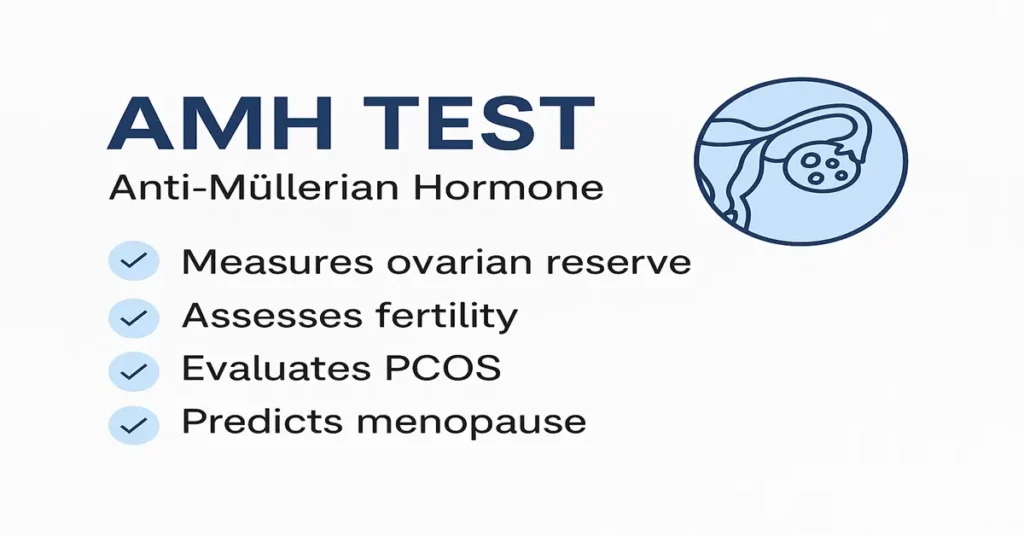
The AMH (Anti-Mullerian Hormone) Test is a blood test used to measure the level of AMH in the body. AMH is produced by small, developing follicles within the ovaries and is widely used as an indicator of ovarian reserve, which refers to the number of eggs remaining in the ovaries.
In everyday clinical terms, AMH helps doctors understand how the ovaries are functioning and how they may respond to fertility-related treatments, including assisted reproductive techniques such as IVF. Unlike many other reproductive hormones, AMH levels remain relatively stable across the menstrual cycle, which makes this test particularly useful in routine evaluation.
The test is commonly requested during fertility assessment, in the evaluation of conditions such as Polycystic Ovary Syndrome (PCOS), and when doctors need to monitor ovarian function during or after certain medical treatments.
What is AMH (Anti-Mullerian Hormone)?
AMH is a protein hormone produced by granulosa cells that surround immature eggs in the ovaries. Its level reflects the pool of small follicles that have the potential to mature in the future.
Across a woman’s lifespan, AMH follows a predictable pattern. Levels are higher during the reproductive years and gradually decline with age, eventually becoming very low or undetectable after menopause.
Although AMH also plays an important role in male fetal development, routine AMH testing in adults is primarily focused on female reproductive health and fertility assessment.
Where is AMH Produced in the Body?
In females, AMH is produced in the ovaries by granulosa cells of early-stage follicles, specifically pre-antral and small antral follicles. These follicles represent the remaining egg pool rather than eggs ready for immediate ovulation.
In males, AMH is produced by the testes during fetal life and is involved in normal reproductive tract development. After birth and into adulthood, AMH measurement is far less commonly required in males, except in specific pediatric or endocrine evaluations.
For adult women, ovarian production of AMH is the main focus, as it provides indirect insight into remaining reproductive potential.
Main Functions and Importance
AMH does not directly control ovulation or hormone cycles, but its clinical value lies in what it represents. It offers a practical window into ovarian reserve rather than egg quality.
Doctors commonly use AMH to estimate how the ovaries might respond to fertility treatments and to support the diagnosis of conditions such as PCOS, where multiple small follicles are often present. It is also helpful when monitoring ovarian function in women who have undergone medical treatments that may affect the ovaries.
In certain pediatric or endocrine settings, AMH may assist in evaluating reproductive development, but in routine practice its importance is greatest in female fertility and ovarian assessment.
Causes of Low AMH Levels
Low AMH levels generally indicate a reduced number of remaining ovarian follicles. This finding is often part of the natural aging process, particularly as women move through their mid-30s and beyond.
In some cases, low AMH may also be seen earlier in life due to medical conditions or prior treatments that affect ovarian tissue. Clinically, a low value is viewed as a signal of diminished ovarian reserve rather than a diagnosis on its own.
Symptoms of Low AMH Levels
Low AMH itself does not cause symptoms. It is a laboratory marker, not a disease.
When symptoms are present, they usually relate to underlying reproductive or hormonal changes, such as difficulty conceiving or changes in menstrual patterns. Doctors interpret AMH results alongside clinical history, cycle patterns, and other hormone tests before drawing conclusions.
Causes of High AMH Levels
High AMH levels suggest a larger number of small ovarian follicles. In clinical practice, this pattern is most often associated with Polycystic Ovary Syndrome, where follicle development is altered.
Less commonly, elevated AMH may be seen in other hormonal or ovarian conditions. As with low values, a high AMH result is interpreted as a clinical signal that prompts further evaluation rather than a diagnosis by itself.
Symptoms of High AMH Levels
High AMH does not produce symptoms directly. When symptoms occur, they are usually related to the underlying condition associated with the elevated level, such as cycle irregularity or features of hormonal imbalance.
Doctors rely on AMH in combination with ultrasound findings, menstrual history, and other hormone tests to understand the broader clinical picture.
Reference Ranges (Normal AMH Levels)
AMH reference ranges vary with age and laboratory method. In general, values within the expected range for reproductive age are considered normal, while lower levels suggest reduced ovarian reserve and higher levels suggest increased follicle numbers.
Because AMH naturally declines with age, results are always interpreted in relation to a woman’s age and clinical situation. The reference range provided by the testing laboratory should be used as the primary comparison.
Sample Type
The AMH test is performed on a blood sample, usually collected as serum in a plain or serum separator tube. Fasting is not required.
One practical advantage of AMH testing is that it can be done on any day of the menstrual cycle, as levels remain relatively stable and are not significantly influenced by short-term hormonal fluctuations.
Why the AMH Test is Important
AMH testing plays an important role in fertility planning and reproductive health assessment. It helps doctors estimate ovarian reserve before fertility treatments, supports the evaluation of PCOS, and assists in monitoring ovarian function after medical or surgical interventions.
In some cases, AMH is also used as part of a broader assessment to understand reproductive aging or to guide discussions about future fertility options.
Test Preparation
No special preparation, such as fasting or dietary restriction, is usually required for an AMH test. Regular medications are typically continued unless otherwise advised by a doctor.
Patients are encouraged to inform their healthcare provider about any hormonal medications or treatments, as these may have a modest influence on test interpretation.
When to Consult a Doctor
AMH testing may be discussed with a doctor if there are concerns about fertility, irregular or absent menstrual cycles, or symptoms suggestive of hormonal imbalance. It is also commonly considered when planning assisted reproductive treatments or before medical therapies that could affect ovarian function.
A healthcare professional can help determine whether AMH testing is appropriate and how the results should be understood in the context of individual health goals.
Important Word Explanations
- Ovarian Reserve: The estimated number of eggs remaining in the ovaries.
- Follicles: Small fluid-filled structures in the ovaries that contain immature eggs.
- Granulosa Cells: Cells surrounding the egg that produce hormones, including AMH.
- IVF (In Vitro Fertilization): A fertility treatment in which eggs are fertilized outside the body.
- PCOS: A hormonal condition associated with irregular cycles and multiple small ovarian follicles.
~END~
Related Posts
None found