
Overview
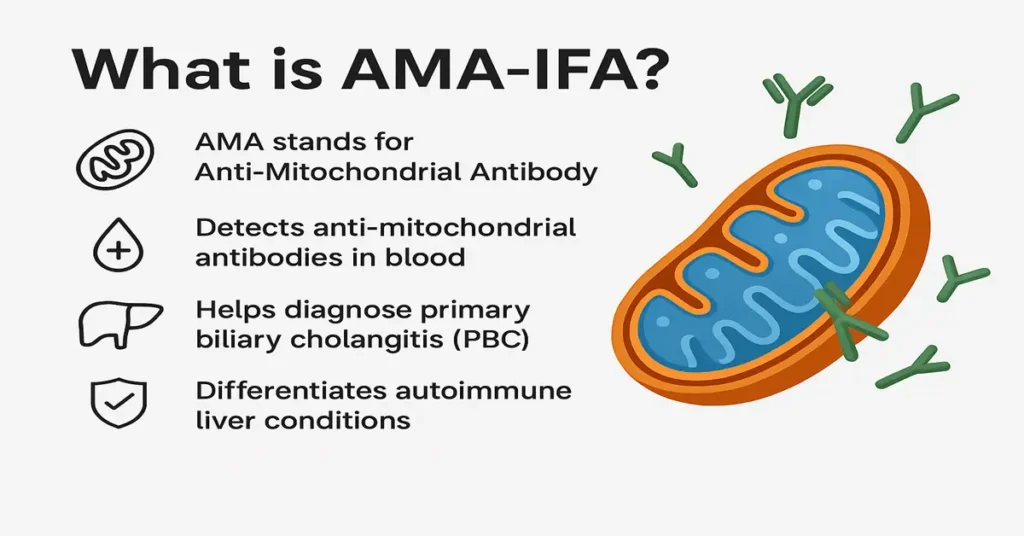
The AMA-IFA Test (Anti-Mitochondrial Antibody – Indirect Immunofluorescence Assay) is a blood test used to detect anti-mitochondrial antibodies (AMAs) in the bloodstream. These antibodies belong to a group known as autoantibodies, meaning they are produced when the immune system reacts against the body’s own structures. In this case, the target is the mitochondria, which are responsible for energy production inside cells.
In clinical practice, the presence of AMA has a strong association with a chronic autoimmune liver condition called Primary Biliary Cholangitis (PBC). This disease primarily affects the small bile ducts within the liver and tends to progress slowly over time. The AMA-IFA test is therefore commonly used to support the diagnosis of PBC, to help distinguish it from other autoimmune liver disorders, and to assist clinicians in assessing disease patterns over time.
What is AMA-IFA?
AMA refers to Anti-Mitochondrial Antibody. IFA stands for Indirect Immunofluorescence Assay, a laboratory technique used to detect these antibodies.
In this method, a patient’s serum is exposed to cells containing mitochondria. If AMAs are present, they bind to mitochondrial structures. A fluorescent marker is then added, allowing these antibody-mitochondria complexes to be visualized under a special microscope. The resulting fluorescence pattern helps the laboratory determine whether the test is positive and, if so, the relative strength of the antibody response.
In simple terms, AMA-IFA is a sensitive blood test that looks for immune activity directed against mitochondria, most often in the context of autoimmune liver disease.
Where is AMA Produced in the Body?
Anti-mitochondrial antibodies are produced by the immune system, specifically by B-cells. They are not made by the liver itself.
In autoimmune conditions, the immune system misidentifies normal cellular components as foreign. In the case of AMA, mitochondria become the unintended target. Although these antibodies circulate in the blood, their effects are most noticeable in the liver, particularly in the small bile ducts. Over time, this immune-mediated process can interfere with normal bile flow and contribute to chronic inflammation within the liver.
Main Functions and Importance
Anti-mitochondrial antibodies do not have any normal or protective function. Their significance lies entirely in what their presence indicates.
From a diagnostic point of view, AMA-IFA testing plays an important role in evaluating suspected autoimmune liver disease. A positive result strongly supports the diagnosis of Primary Biliary Cholangitis and helps differentiate it from other liver conditions that may appear similar on routine blood tests or imaging.
Clinicians may also use AMA results alongside other investigations to understand disease activity and patterns, particularly when symptoms or liver enzyme changes are unexplained.
Causes of Low or Negative AMA Levels
A low or negative AMA-IFA result means that anti-mitochondrial antibodies are not detected in the blood. This finding is considered normal in healthy individuals.
Negative results are also commonly seen in liver conditions that are not autoimmune in nature, such as fatty liver disease, alcohol-related liver injury, or viral hepatitis. In a small number of cases, people with clinical features suggestive of PBC may still test negative for AMA, a situation sometimes referred to as AMA-negative PBC. In such cases, doctors rely more heavily on other laboratory findings and clinical assessment.
Symptoms of Low/Negative AMA Levels
Low or negative AMA levels do not cause symptoms. The result simply reflects the absence of detectable anti-mitochondrial antibodies.
If symptoms suggestive of autoimmune liver disease are present despite a negative AMA test, clinicians usually consider additional antibody tests or other diagnostic tools to clarify the cause.
Causes of High or Positive AMA Levels
A positive AMA-IFA result indicates an autoimmune response directed against mitochondria. In routine clinical settings, this finding is most strongly linked to Primary Biliary Cholangitis, where the vast majority of patients show AMA positivity.
Positive results may also be seen in other autoimmune or chronic inflammatory conditions involving the liver or, less commonly, in systemic autoimmune disorders. Because of this, AMA results are always interpreted in combination with liver function tests, clinical symptoms, and imaging findings rather than on their own.
Symptoms of High AMA Levels (Commonly Seen in PBC)
When AMA positivity reflects an underlying autoimmune liver condition, symptoms are usually related to impaired bile flow and chronic liver inflammation. Patients may report ongoing fatigue or itching, and some experience dryness of the eyes or mouth.
As liver involvement progresses, features such as upper abdominal discomfort or jaundice may appear. It is important to note that symptoms often develop gradually, and some individuals may have a positive AMA test long before noticeable clinical signs emerge.
Reference Ranges and Interpretation
AMA-IFA results are reported as titers, which represent how strongly antibodies are detected at increasing dilutions of the blood sample.
A negative result indicates no detectable antibodies. Lower-level positive titers may require correlation with other tests and clinical findings, while higher titers increase the likelihood of an autoimmune liver process, particularly PBC.
Because laboratory techniques and reporting standards can vary, results should always be interpreted using the reference information provided by the testing laboratory and in the context of the patient’s overall evaluation.
Sample Type and Collection
The AMA-IFA test is performed on a blood sample, typically collected as serum in a plain or serum separator tube. Fasting is not usually required.
Once collected, the sample is processed in the laboratory using immunofluorescence microscopy to identify characteristic antibody binding patterns. Proper sample handling ensures accurate visualization and interpretation.
Why AMA-IFA Test is Important
AMA-IFA is considered a key laboratory marker in the evaluation of autoimmune liver disease. It allows clinicians to identify PBC at an early stage, sometimes even before significant liver damage has occurred.
The test also helps distinguish autoimmune causes of liver dysfunction from viral, metabolic, or alcohol-related conditions. In addition, it may alert doctors to the possibility of associated autoimmune disorders, prompting a broader clinical assessment.
Test Preparation
No special preparation, such as fasting, is generally required for the AMA-IFA test. Patients are usually advised to inform their doctor about any medications they are taking, particularly those that affect immune function.
Depending on the clinical situation, AMA-IFA may be requested alongside other blood tests or imaging studies to build a complete picture of liver health.
When to Consult a Doctor
Medical evaluation is advised if a person experiences persistent fatigue, unexplained itching, jaundice, or ongoing upper abdominal discomfort. Dry eyes or dry mouth, especially when combined with abnormal liver tests, may also prompt further investigation.
Individuals with a family history of autoimmune liver disease or unexplained liver enzyme abnormalities may be referred to a specialist for targeted testing, including AMA-IFA.
Important Word Explanations
- Antibody: A protein produced by the immune system; autoantibodies mistakenly target the body’s own tissues.
- Mitochondria: Structures within cells responsible for energy production.
- Autoimmune: A condition in which the immune system attacks normal body components.
- Cholangitis: Inflammation of the bile ducts within the liver.
- Titer: A laboratory measure indicating the relative amount or strength of an antibody in the blood.
~END~
Related Posts
None found