
Overview
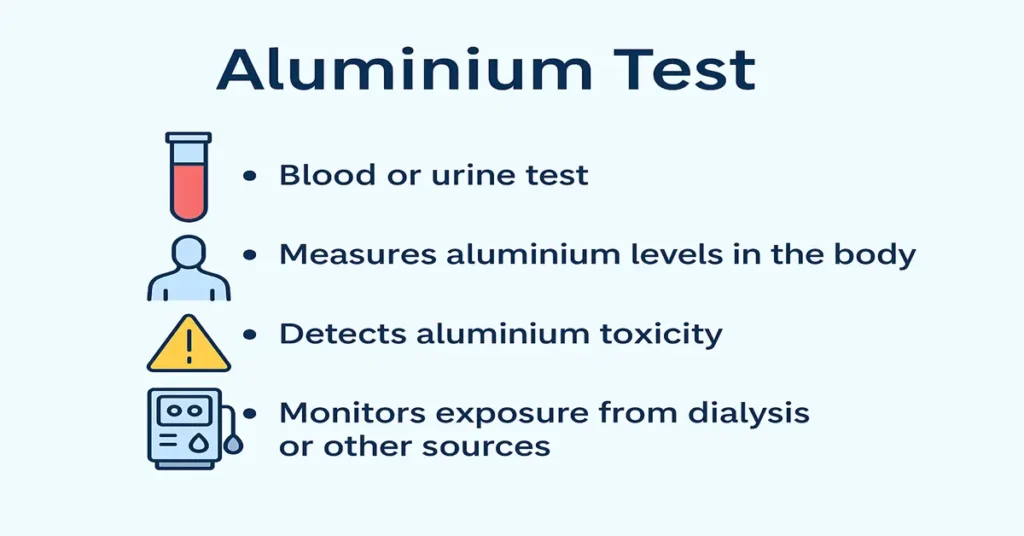
The Aluminium Test is a laboratory investigation performed on blood or urine samples to assess how much aluminium is present in the body at a given time. Aluminium is a naturally occurring metal found widely in the environment, including air, water, food, and some medications.
In healthy individuals, small amounts of aluminium exposure are usually handled without difficulty. Problems arise when exposure is prolonged or when the body’s ability to remove aluminium is reduced, most commonly due to impaired kidney function. In such situations, aluminium can accumulate slowly and lead to toxicity.
From a clinical standpoint, this test is mainly used to:
- Detect aluminium toxicity
- Monitor aluminium exposure in high-risk occupations
- Assess aluminium accumulation in patients undergoing long-term dialysis
What is Aluminium?
Aluminium is considered a non-essential metal for humans. Unlike iron or calcium, it does not play any required role in normal body processes. Under usual circumstances, trace amounts that enter the body through food or the environment are filtered and eliminated by the kidneys.
When kidney function is reduced, this elimination becomes inefficient. Over time, aluminium can remain in the circulation and deposit in various tissues. Clinically, this slow accumulation is what raises concern, rather than short-term or minimal exposure.
Where Aluminium is Found or Accumulates in the Body
The human body does not produce aluminium on its own. Exposure comes entirely from external sources, such as everyday environmental contact or medical and occupational settings.
Once aluminium enters the body and is not adequately cleared, it tends to accumulate in specific tissues. The most common storage sites are bones, lungs, brain, and liver. From a laboratory perspective, these are also the organs most vulnerable to long-term effects when aluminium levels remain elevated over time.
Main Functions and Importance of Monitoring
Aluminium has no beneficial biological function. However, monitoring aluminium levels becomes important in certain clinical and occupational situations.
Doctors pay particular attention to aluminium levels in patients with kidney disease on dialysis, as even low but continuous exposure can lead to gradual buildup. Similarly, individuals working in industries involving aluminium processing may require periodic monitoring due to inhalation or contact exposure.
When levels rise, aluminium can interfere with normal bone metabolism, affect brain function, and disrupt red blood cell production. The test helps clinicians recognize these risks early, often before obvious damage occurs.
Causes of Low Aluminium Levels
Low or undetectable aluminium levels are considered normal. In fact, this is what is expected in healthy individuals. The body naturally maintains aluminium at very low concentrations, and there is no known condition caused by aluminium deficiency.
Symptoms of Low Aluminium Levels
There are no symptoms associated with low aluminium levels. Since aluminium is not required for any normal body function, its absence does not affect health.
Causes of High Aluminium Levels
Elevated aluminium levels usually reflect either prolonged exposure or reduced elimination rather than a single short-term event. In clinical practice, high values are most often seen in people with chronic kidney disease or those receiving long-term dialysis.
Other contributing factors may include repeated use of aluminium-containing medications, occupational exposure in certain industries, or contamination from medical solutions such as intravenous nutrition. Continuous low-level exposure is particularly relevant in dialysis patients, where even small amounts can accumulate over time.
Symptoms of High Aluminium Levels (Aluminium Toxicity)
When aluminium accumulates, its effects are typically gradual and may involve multiple organ systems. Bones, brain, and muscles are most commonly affected. Patients may present with persistent bone pain, unexplained fractures, fatigue, or muscle stiffness. Changes in mental function, such as memory difficulties or confusion, may also be noted.
In more advanced cases, neurological involvement can lead to problems with speech, movement, or seizures. In children, aluminium accumulation may interfere with normal growth and development.
Among dialysis patients, a severe form of neurological involvement known as dialysis encephalopathy can occur. Because these features are not specific to aluminium alone, laboratory testing plays a key role in confirming whether aluminium accumulation is contributing to the clinical picture.
Reference Ranges for Aluminium Test
Aluminium levels are interpreted in relation to the sample type and clinical context.
For blood aluminium, values below 10 µg/L are generally considered acceptable, while markedly higher levels raise concern for toxicity, particularly in dialysis patients.
For urine aluminium, low values reflect minimal exposure, whereas higher levels suggest increased exposure or accumulation.
It is important to note that reference ranges may vary slightly between laboratories depending on the method used. Results should always be interpreted alongside the reference range provided in the individual lab report and the patient’s clinical background.
Sample Type and Test Method
The Aluminium Test is most commonly performed using a blood sample, typically serum or plasma. In certain situations, a 24-hour urine collection may be requested to assess aluminium excretion over time.
From a laboratory accuracy perspective, recent intake of aluminium-containing medications can influence results. Informing the doctor about dialysis status, intravenous nutrition, or occupational exposure helps ensure that results are interpreted correctly.
Why the Aluminium Test is Important
Clinically, this test serves as an early warning tool. It helps doctors identify aluminium accumulation before significant organ damage develops, particularly in vulnerable groups such as dialysis patients.
It is also useful in monitoring ongoing exposure in industrial settings and in evaluating unexplained bone disorders, anemia, or neurological findings where aluminium involvement is being considered. The test supports clinical decision-making by clarifying whether aluminium is contributing to the patient’s condition.
How to Reduce Aluminium Exposure
Reducing aluminium exposure is primarily a preventive consideration and is usually addressed by healthcare providers based on individual risk factors. This may involve reviewing sources of exposure, medical products, or occupational conditions that contribute to elevated levels.
Test Preparation
In most cases, fasting is not required before an Aluminium Test. Patients are usually advised to avoid aluminium-containing medications for a short period before testing, if clinically appropriate.
If a 24-hour urine sample is requested, careful adherence to collection instructions is important to ensure reliable results. Informing the healthcare provider about dialysis treatment, medications, or workplace exposure helps place the test result in proper context.
When to Consult a Doctor
Medical consultation is recommended for individuals with chronic kidney disease, those undergoing dialysis, or anyone with persistent bone pain, unexplained anemia, or neurological symptoms.
People with known occupational exposure to aluminium should also seek medical advice if symptoms develop or if monitoring is advised. A doctor may recommend further evaluation or repeat testing based on overall clinical findings.
Important Word Explanations
- Toxicity: Harmful effects caused by excessive accumulation of a substance in the body.
- Dialysis: A medical procedure that removes waste products and excess fluids from the blood when the kidneys cannot do so adequately.
- Encephalopathy: A general term describing impaired brain function, often presenting as confusion or memory changes.
- Chelation Therapy: A medical approach used in specific situations to help remove certain metals from the body.
- µg/L: Micrograms per liter, a unit used to measure very small concentrations of substances in blood or urine.
~END~