
ALT Test: Purpose, Importance, Normal Ranges & When It Becomes Risky
What Is the ALT Test?
The ALT test measures Alanine Aminotransferase, an enzyme found mainly inside liver cells. ALT plays a role in protein metabolism and helps the liver convert nutrients into usable energy.
When liver cells are healthy, only a small amount of ALT circulates in the blood. If the liver becomes irritated, inflamed, or stressed, ALT leaks out of the cells and the blood level starts to rise. Because of this behavior, ALT is considered one of the most liver-specific enzymes used in routine blood testing.
Although ALT is part of the Liver Function Test (LFT) panel, clinicians often give it special attention because it reflects liver cell irritation more directly than many other parameters.
Purpose of the ALT Test
Doctors request an ALT test to understand how the liver is responding to various stresses, sometimes even before symptoms appear.
To detect liver inflammation (hepatitis)
ALT rises early when liver inflammation occurs. This includes viral hepatitis, autoimmune inflammation, drug-related injury, alcohol-related irritation, and acute liver infections. In day-to-day practice, ALT is often the first enzyme to alert doctors to ongoing liver cell damage.
To diagnose fatty liver disease
Fatty liver is very common today due to lifestyle, weight issues, metabolic problems, and alcohol use. ALT helps indicate whether fat inside the liver is causing active irritation rather than just fat accumulation alone.
To monitor alcohol effects on the liver
ALT levels help doctors assess how alcohol is affecting liver cells and whether the liver is improving after alcohol reduction or stoppage.
To check medication safety
Many routine medicines can irritate liver cells. ALT helps detect early liver stress from statins, painkillers, antibiotics, anti-seizure drugs, anti-tuberculosis medicines, and some herbal products, allowing timely adjustment before serious damage occurs.
To evaluate muscle stress (supportive role)
ALT is mainly a liver enzyme, but mild increases can be seen with muscle strain or injury. Doctors interpret ALT alongside AST and creatine kinase when muscle involvement is suspected.
To monitor treatment progress
In people being treated for hepatitis, fatty liver, or alcohol-related liver stress, repeated ALT testing helps track whether the liver is recovering or if inflammation is continuing.
Why Is the ALT Test Important?
Early warning before symptoms
Most liver problems do not cause pain or visible symptoms initially. ALT can rise quietly, giving doctors an early chance to intervene.
Helps identify the pattern of liver injury
ALT is interpreted together with AST, ALP, GGT, and bilirubin. This pattern helps doctors decide whether the issue is liver inflammation, bile duct blockage, alcohol-related stress, or medication toxicity.
Important for people with lifestyle risks
Individuals who consume alcohol, smoke, are overweight, have diabetes, use supplements, or take long-term medications benefit from regular ALT monitoring.
Useful during pregnancy
ALT testing helps detect pregnancy-related liver conditions such as cholestasis, fatty liver of pregnancy, or preeclampsia-related liver stress, where early detection is crucial.
Normal Ranges of ALT
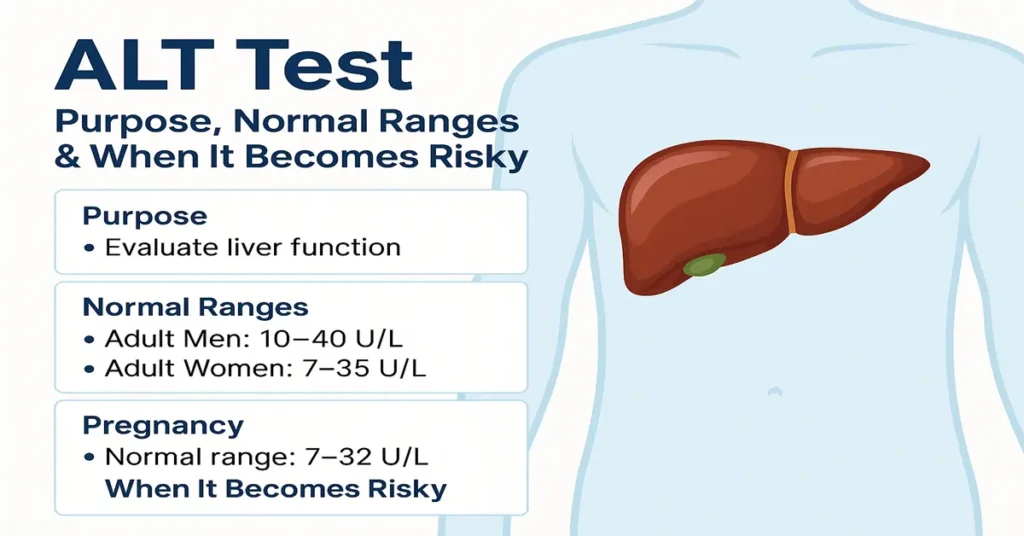
ALT values can vary slightly between laboratories, but commonly accepted ranges are:
Adult men
Approximately 10–40 U/L
Adult women
Approximately 7–35 U/L
Women often have slightly lower values due to hormonal and metabolic differences.
Children
Children may show mildly higher values due to growth and active metabolism, usually around 10–45 U/L.
Newborns
Newborns can naturally have higher ALT due to rapid liver development, often up to 20–70 U/L.
Pregnancy
ALT generally remains within the adult female range, with minor fluctuations. Persistent elevation during pregnancy always needs evaluation.
Symptoms Linked to High or Abnormal ALT Levels
ALT itself does not cause symptoms. Any symptoms come from the underlying condition affecting the liver.
Commonly reported symptoms include persistent fatigue, nausea, right-sided abdominal discomfort, bloating, reduced appetite, yellowing of the eyes or skin, dark urine, pale stools, itching, muscle weakness, and swelling in advanced liver disease.
Clinically, doctors correlate symptoms with ALT trends rather than relying on a single value.
When Does ALT Become Risky?
Mild elevation (up to about twice normal)
Often seen with fatty liver, mild dehydration, recent heavy exercise, or medication effects. Usually monitored rather than treated urgently.
Moderate elevation (about 2–5 times normal)
Suggests active liver stress such as alcohol-related irritation, medication toxicity, early hepatitis, or active fatty liver. Needs medical attention.
Very high ALT (above 300–500 U/L)
Considered serious. Seen in acute hepatitis, severe liver injury, toxic exposure, autoimmune flares, or sudden viral activity. Requires urgent evaluation.
ALT elevation during pregnancy
Any significant rise needs prompt assessment to rule out pregnancy-specific liver conditions.
Factors That Can Influence ALT Results
ALT may rise temporarily due to intense workouts, recent alcohol intake, dehydration, poor sleep, heavy fatty meals, smoking, or certain supplements. This is why doctors often repeat the test before drawing conclusions.
What Doctors Usually Do When ALT Is High
Rather than reacting to a single value, doctors typically advise repeat testing and supportive investigations such as a full LFT panel, ultrasound abdomen, viral hepatitis screening, diabetes and lipid tests, thyroid profile, and medication review. This step-by-step approach avoids over-diagnosis and missed causes.
Test Preparation
ALT testing does not require fasting. Avoid alcohol for at least 48 hours and heavy exercise for 24 hours before testing. Stay hydrated, avoid very fatty meals beforehand, and inform your doctor about all medicines and supplements.
When to Consult a Doctor
Medical advice is important if ALT stays high on repeated tests, jaundice or severe fatigue appears, abdominal pain persists, urine becomes dark, or you have known risk factors such as fatty liver, diabetes, obesity, or regular alcohol intake. Early evaluation protects long-term liver health.
Important Word Explanations
ALT: Liver enzyme released when liver cells are irritated or damaged
Enzymes: Proteins that help chemical reactions occur in the body
Hepatitis: Inflammation of the liver
Cholestasis: Reduced or blocked bile flow
Steatosis: Fat accumulation inside liver cells
LFT: Liver Function Test panel
Metabolic stress: Liver strain due to diet, alcohol, hormones, or disease
People Also Ask
Is a high ALT result always serious?
Not always. Mild elevations are common and often reversible.
Can ALT rise temporarily?
Yes. Exercise, alcohol intake, dehydration, infections, or short-term medication use can cause temporary increases.
Does high ALT always mean liver disease?
Usually it reflects liver stress, but the cause may be mild, temporary, or lifestyle-related rather than permanent disease.
When do doctors usually worry about ALT?
When levels stay high, rise quickly, or appear with symptoms and other abnormal liver tests.
Is repeat ALT testing common?
Yes. Repeat testing helps confirm whether the elevation is temporary or ongoing.
Can ALT return to normal naturally?
In many cases, yes—once the underlying cause is corrected and the liver recovers.
~END~
Your explanations reduced my stress before taking the test. I appreciate how informative and easy to read your blogs are.
It’s going to be end of mine day, except before finish I am reading this enormous piece of writing
to increase my know-how.
Hi there! I could have sworn I’ve been to this site before
but after browsing through some of the post I realized it’s new to me.
Anyhow, I’m definitely delighted I found it and I’ll be
bookmarking and checking back frequently!
It’s actually a cool and helpful piece of information. I am satisfied that you simply shared this
helpful info with us. Please keep us informed like this.
Thank you for sharing.
What’s up to all, how is the whole thing, I think every one is getting more from this site, and your views are fastidious
designed for new users.
Thanks in support of sharing such a fastidious idea, piece of writing is pleasant, thats why i have read it entirely
Why viewers still use to read news papers when in this technological world all is existing
on web?
The ‘Important Word Explanations’ section was the best part. It made everything much easier.
I want to to thank you for this excellent read!! I certainly enjoyed every bit
of it. I have got you book marked to look at new things you post…
Hi there to every body, it’s my first pay a quick visit of this blog; this webpage includes remarkable and really
good stuff in support of visitors.
I’ve been surfing online more than 4 hours today, yet I
never found any interesting article like yours. It’s pretty
worth enough forr me. Personally, iff all webmasters
andd bloggers made good content ass you did, the weeb will be mch more useful
than ever before.
wonderful points altogether, you just received a emblem
neww reader. What mivht you recommend in regards
to your post that you just made a few days ago? Any sure?
Whoa! This blog looks exactly like my old one! It’s on a completely different subject but it has
pretty much the same page layout and design. Great choice of colors!
Appreciate the recommendation. Let me try it out.
I really love your blog.. Pleasant colors & theme. Did you develop this amazing site yourself?
Please reply back as I’m trying to create my very own website and would like
to learn where you got this from or exactly what the theme
is named. Cheers!
Have you ever considered writing an ebook
or guest authoring on other sites? I have a blog centered on the same topics you discuss and would love to
have you share some stories/information. I know my visitors would value your work.
If you’re even remotely interested, feel free to send
me an email.