
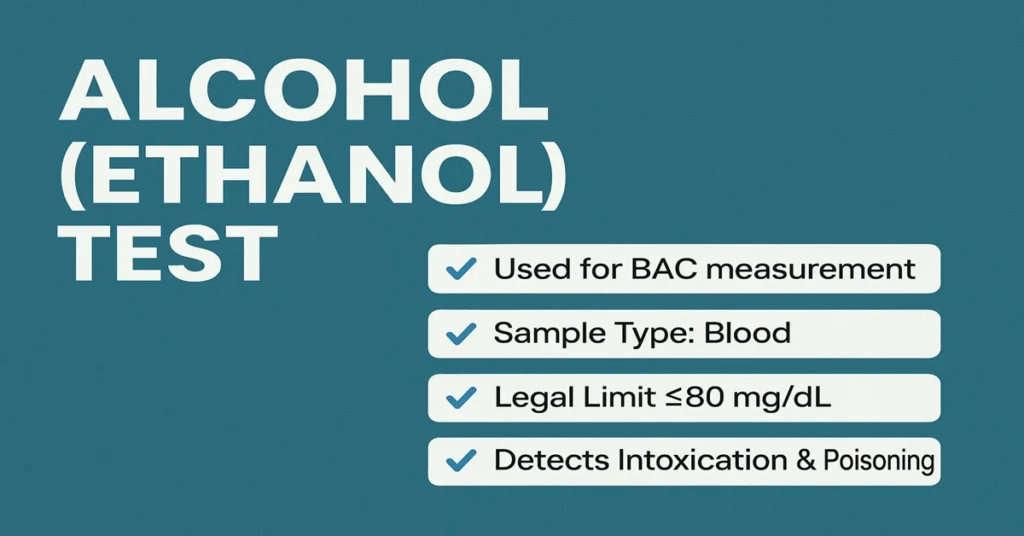
What is the Alcohol (Ethanol) Test?
The Alcohol (Ethanol) Test is a laboratory test used to measure the amount of ethyl alcohol (ethanol) present in the blood. It provides an objective estimate of blood alcohol concentration (BAC), which reflects recent alcohol intake and its effect on the body.
This test is commonly performed in hospital emergency departments, intensive care units, and forensic laboratories. Clinically, it helps doctors assess alcohol intoxication or poisoning, especially when a patient is unconscious, confused, or unable to provide a history. In non-medical settings, it also supports legal and forensic evaluations where alcohol involvement needs to be documented.
Where is Alcohol Metabolized in the Body?
Alcohol is not produced naturally by the human body. Once consumed, it is rapidly absorbed from the stomach and small intestine into the bloodstream. From there, it is distributed throughout body tissues, including the brain and liver.
The liver is the primary organ responsible for alcohol metabolism. This process occurs in steps:
- Alcohol is first converted into acetaldehyde by alcohol dehydrogenase.
- Acetaldehyde is then converted into acetic acid by aldehyde dehydrogenase.
- Acetic acid is further broken down into carbon dioxide and water.
A small fraction of alcohol escapes metabolism and is excreted unchanged through breath, urine, and sweat. This is the basis for breath-based alcohol testing, although blood measurement remains the most precise method.
Main Functions and Importance of the Alcohol (Ethanol) Test
The Alcohol Test serves both medical and forensic purposes.
In healthcare settings, it helps confirm whether alcohol is contributing to altered consciousness, behavioral changes, or metabolic disturbances. It is particularly useful when symptoms could be caused by multiple conditions, such as head injury, stroke, infection, or drug exposure.
In monitored care or rehabilitation programs, the test may be used to document alcohol clearance over time. In forensic contexts, measured BAC levels provide legally defensible evidence in situations such as road traffic incidents, workplace accidents, or criminal investigations.
Causes of Low Alcohol Levels
Low or undetectable alcohol levels are expected in individuals who have not consumed alcohol recently. This finding generally reflects normal physiology.
Low readings may also be seen when sufficient time has passed since alcohol intake, allowing the liver to metabolize most of the ethanol. In clinical monitoring, declining levels can indicate ongoing clearance of alcohol from the bloodstream.
Symptoms of Low Alcohol Levels
There are no symptoms associated with low or zero blood alcohol levels. Such results simply indicate the absence of circulating alcohol and do not carry clinical significance on their own.
Causes of High Alcohol Levels
Elevated blood alcohol levels indicate recent alcohol intake exceeding the body’s capacity to metabolize it efficiently. The degree of elevation depends on the amount consumed, the speed of intake, and individual metabolic differences.
Higher levels may be observed in situations such as excessive or rapid alcohol consumption, impaired liver function, interactions with certain medications, or inherited differences in alcohol-metabolizing enzymes. These factors influence how long alcohol remains detectable in the bloodstream.
Symptoms of High Alcohol Levels (Intoxication)
Alcohol itself acts as a central nervous system depressant. As blood levels rise, neurological and physical effects become more pronounced.
At lower elevations, individuals may show reduced inhibition, slowed reaction time, and mild coordination issues. With increasing levels, impaired balance, confusion, and drowsiness become more evident. Very high levels are associated with suppression of breathing, reduced consciousness, and loss of protective reflexes.
Symptoms reflect the effect of alcohol on the brain and vital organs rather than the numeric value alone.
Reference Ranges (Blood Alcohol Concentration – BAC)
Blood alcohol concentration is reported in milligrams per deciliter (mg/dL) or as a percentage.
A value of 0 mg/dL indicates no detectable alcohol. Increasing values correspond to progressively greater levels of intoxication, with very high readings signaling a medical emergency. Legal driving limits are defined by law and vary by country, but medical impairment can occur even below these thresholds.
BAC values must always be interpreted in clinical context, considering symptoms, timing of ingestion, and patient factors.
Sample Type and Collection Methods
The Alcohol Test is most accurately performed using a blood sample, collected in a tube containing preservatives that prevent fermentation or breakdown of alcohol after collection.
Alternative testing methods include breath, urine, or saliva analysis, which are often used for screening. However, blood testing remains the reference standard for both medical decision-making and forensic documentation.
How the Alcohol Test is Performed
A blood sample is drawn from a vein using sterile technique and collected in a preservative-containing tube. In emergency or legal settings, strict procedures are followed to ensure sample integrity.
Laboratories measure ethanol concentration using validated methods such as enzymatic analysis or gas chromatography. These techniques provide precise and reproducible results.
Interpreting Alcohol Test Results
Alcohol test results are interpreted by correlating the measured level with clinical findings.
Undetectable levels indicate no circulating alcohol. Mild to moderate elevations suggest recent intake with varying degrees of impairment. Markedly elevated levels indicate severe intoxication and may explain altered mental status or respiratory suppression.
Individual tolerance, body composition, liver function, and concurrent drug use can influence how a given level affects a person.
Test Preparation
No fasting is required for alcohol testing.
For routine evaluations, patients are usually advised to avoid alcohol beforehand. In emergency or forensic situations, testing is performed immediately, without preparation, to capture the current physiological state.
Patients should inform healthcare providers about recent alcohol intake or medications, as this information aids interpretation.
When to Consult a Doctor
Medical evaluation is important if a person experiences confusion, vomiting, severe drowsiness, breathing difficulty, loss of coordination, or unconsciousness following alcohol intake.
Persistent symptoms, repeated episodes of intoxication, or signs of withdrawal also warrant medical attention. The Alcohol Test helps clinicians assess severity and guide further evaluation.
Important Word Explanations
- Ethanol: The type of alcohol found in alcoholic beverages
- BAC (Blood Alcohol Concentration): The amount of alcohol present in the blood
- Alcohol Dehydrogenase: Liver enzyme that converts ethanol into acetaldehyde
- Aldehyde Dehydrogenase: Enzyme that further breaks down acetaldehyde
- Cirrhosis: Chronic liver damage that may impair alcohol metabolism
- Forensic Test: A legally valid laboratory test used in investigations
~END~