
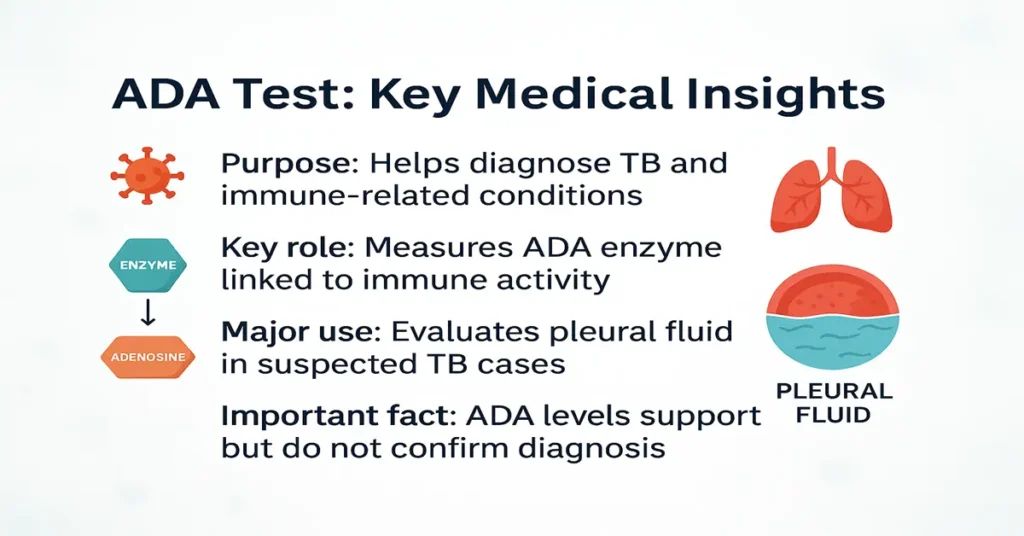
What Is ADA Test
Why This Test Is Done
The Adenosine Deaminase (ADA) test is used to measure the activity of the ADA enzyme in different body fluids. In routine lab and OPD practice, this test is mainly requested when doctors want to understand whether the immune system is actively involved in a disease process. ADA plays a key role in immune cell function, especially lymphocytes, so its level often rises when the body is fighting infection or dealing with ongoing inflammation.
Clinically, the ADA test is most closely associated with Tuberculosis, particularly when there is fluid collection around the lungs, known as Pleural Effusion. In such situations, ADA helps doctors decide whether the fluid is likely due to TB or some other cause. Because the test is relatively simple, cost-effective, and widely available, it is often included early in the evaluation of patients with fever, cough, chest symptoms, or unexplained fluid buildup.
The ADA test does not give a final diagnosis on its own. Instead, it helps answer an important clinical question: is the immune system strongly activated in this condition or not?
Biological Role and Functions of ADA
To understand the importance of the ADA test, it helps to look at what ADA does inside the body. ADA is an enzyme involved in the breakdown of adenosine, a substance that influences how immune cells behave. By controlling adenosine levels, ADA indirectly regulates immune activity and inflammation.
In day-to-day medical terms, ADA has a few key roles:
It supports normal immune cell development, especially T-lymphocytes. When ADA activity is normal, immune cells can grow and function properly.
It reflects immune activation. During infections or inflammatory conditions, immune cells become more active and release more ADA.
It helps maintain healthy lymphocyte function. Since lymphocytes contain high amounts of ADA, changes in immune status are often mirrored by ADA levels.
It prevents toxic buildup of adenosine inside immune cells, which could otherwise impair their survival.
Because ADA is so closely linked to immune function, measuring it gives doctors a useful snapshot of how active the immune system is at that moment.
Medical Importance of Measuring This Parameter
The ADA test has practical importance in several common clinical situations, especially where symptoms and imaging findings are not very specific.
In suspected tuberculosis, particularly pleural TB, a high ADA level in pleural fluid strongly supports the diagnosis when combined with symptoms and radiological findings. In many hospitals, this test helps doctors start timely investigations and treatment rather than waiting for slower confirmatory tests.
When fluid accumulates in body cavities such as the chest, abdomen, or around the heart, ADA helps differentiate between infectious or inflammatory causes and non-infectious causes like heart failure or malignancy. Clinically, this distinction is very important because it changes the entire management plan.
ADA can also rise in other infections, chronic inflammatory diseases, and some cancers. In these situations, the value does not point to one disease but tells the clinician that immune activation is significant and further evaluation is needed.
In practice, ADA acts as a guidepost. It helps doctors decide which direction to investigate next, rather than serving as a final answer.
Conditions Diagnosed Using This Test
The ADA test supports the diagnosis of several conditions, depending on the type of sample tested.
In tuberculosis involving body fluids, ADA is most useful. Pleural fluid ADA is commonly used in suspected pleural TB. ADA may also be measured in peritoneal fluid for abdominal TB, pericardial fluid for TB around the heart, and cerebrospinal fluid in selected cases of TB meningitis.
In lymphomas and some other cancers, ADA may be elevated due to immune system involvement or secondary inflammation. This finding is supportive but never diagnostic by itself.
In chronic liver diseases and autoimmune or inflammatory disorders, ADA can rise as part of ongoing immune activity. Here, it helps indicate disease activity rather than confirming a specific diagnosis.
In persistent or unexplained infections, ADA adds information when routine tests are inconclusive.
Limitations of the Test
Although ADA is a valuable test, it has clear limitations that clinicians keep in mind.
A high ADA level cannot diagnose tuberculosis on its own. Other infections and inflammatory diseases can give similar results, so confirmation with imaging, microbiology, or biopsy is often required.
Reference ranges vary between laboratories, depending on methods and reagents. Results should always be interpreted using the range provided on the report.
ADA measured in blood is generally less specific than ADA measured in body fluids. This is why fluid ADA is preferred in TB evaluation.
In early or mild disease, ADA levels may still be normal. A normal result does not always exclude disease if clinical suspicion is high.
Understanding these limitations helps avoid over-interpretation and unnecessary anxiety.
Additional Information
In real clinical settings, ADA is rarely looked at in isolation. Doctors usually interpret it alongside chest X-rays, CT scans, microbiological tests, and the patient’s symptoms. In areas where TB is common, ADA has become an important supportive test because it provides quick and useful information.
Because ADA reflects immune activity, it may also be followed over time in selected cases to understand disease progression, although this depends on the underlying condition.
Test Preparation
Most patients do not need special preparation for an ADA test. Eating and drinking are usually allowed. However, it is helpful to inform the doctor about current symptoms, recent infections, any past history of tuberculosis, and ongoing medications such as steroids or immunosuppressants. This context helps the doctor interpret the result correctly.
When to See a Doctor
Medical advice should be sought if you have persistent cough, fever, night sweats, chest pain, breathlessness, abdominal swelling, unexplained weight loss, or long-standing fatigue. If an ADA test result is high, a doctor should always review it and plan further evaluation rather than relying on the number alone.
Sample Type
The ADA test can be performed on different sample types based on the clinical situation. These include pleural fluid, peritoneal fluid, pericardial fluid, cerebrospinal fluid, and blood serum. Each sample has a different clinical meaning, which is why the sample type is always mentioned in the report.
Important Word Explanations
Adenosine Deaminase (ADA): An enzyme involved in immune system activity.
Pleural Effusion: Collection of fluid around the lungs.
Lymphocytes: White blood cells important for immunity and rich in ADA.
Tuberculosis: A bacterial infection commonly affecting the lungs.
Inflammation: The body’s response to infection or injury.
People Also Ask
Is the ADA test mainly for tuberculosis?
Yes, especially for pleural fluid, but it can also support evaluation of other infections and inflammatory conditions.
Does a high ADA always mean TB?
No. TB is a common cause, but other infections, inflammation, or cancers can also raise ADA levels.
Can ADA be normal even if TB is present?
Yes. In early or mild disease, ADA levels may still be within the normal range.
Is ADA testing done on blood or fluid?
Both are possible, but ADA in body fluids like pleural fluid is usually more informative.
When do doctors rely most on ADA results?
When there is unexplained fluid accumulation and infection is suspected, especially in TB-endemic areas.
Is repeat ADA testing common?
It may be repeated in selected cases, but doctors usually focus more on overall clinical progress.
~END~