
Normal Range of ACTH Test
Why Normal Range Matters
The ACTH (Adrenocorticotropic Hormone) test is mainly used to understand how well the pituitary gland and adrenal glands are working together. In day-to-day clinical practice, the number itself only becomes meaningful when it is compared with the normal reference range. ACTH is a hormone that changes naturally throughout the day and also responds quickly to stress, sleep, illness, and medications.
A value within the normal range usually means that the pituitary gland is sending appropriate signals to the adrenal glands to produce cortisol. When ACTH falls outside this range, doctors start thinking about conditions affecting the pituitary, adrenal glands, or the feedback system between them. Even mild shifts can matter, because cortisol plays a critical role in blood pressure control, metabolism, immunity, and stress response. This is why understanding the normal range is essential before interpreting any result.
General Reference Range
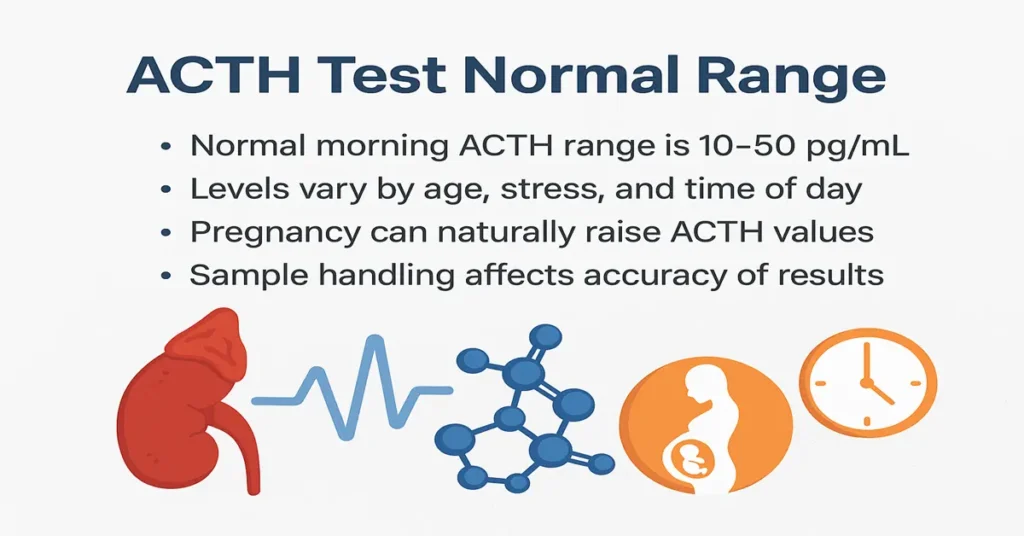
The normal range for ACTH can vary slightly depending on the laboratory method and how the sample is handled. In routine practice, the commonly accepted early-morning reference range for adults is:
10–50 pg/mL (picograms per milliliter)
This range applies when the blood sample is collected in the early morning, usually between 6 AM and 8 AM. ACTH follows a circadian rhythm, meaning it peaks in the morning and gradually falls through the day. Testing outside this time window can give values that appear abnormal even when hormone function is normal.
Some laboratories may report ACTH in different units, such as pmol/L, or use slightly different cut-off values. For this reason, doctors always refer to the range printed on the laboratory report rather than using a fixed number.
Another practical point is sample handling. ACTH is fragile outside the body. If the blood sample is not kept cold and processed quickly, the reported value may be falsely low.
Age-Wise Normal Range
ACTH levels do change with age, though in most cases the differences are subtle.
Newborns and infants
ACTH levels may be slightly higher shortly after birth. This is considered a normal response to birth-related stress and an immature hormone feedback system. Levels gradually stabilize over the first few months.
Children and adolescents
Most children have ACTH values that fall within the adult reference range. During puberty, small fluctuations can occur, but significant abnormalities are uncommon unless an underlying endocrine disorder is present.
Adults
Adults generally show the most stable ACTH pattern. The standard morning range of 10–50 pg/mL is used for most adults across all age groups.
Older adults
With aging, hormonal regulation may become slightly less efficient. Minor variations can be seen, but values usually remain within or close to the normal morning range. Persistent or marked abnormalities always need evaluation.
Gender-Wise Normal Range
ACTH reference ranges are generally the same for men and women.
Men
ACTH levels tend to be stable across adulthood. Temporary changes are usually related to stress, illness, or sleep disruption rather than gender itself.
Women
Women may show slightly more variation due to menstrual cycles, pregnancy, or hormone therapy. Estrogen can influence cortisol-binding and feedback mechanisms, but most values still fall within the standard reference range.
Clinically, doctors focus more on timing, symptoms, and cortisol levels rather than using separate male and female ranges.
Pregnancy-Specific Normal Range
During pregnancy, especially in the later months, ACTH and cortisol levels naturally rise. This increase supports the body’s changing metabolic and stress needs.
ACTH values may cross the usual upper limit without indicating disease. Because of this, doctors interpret ACTH results in pregnancy with caution and almost always look at cortisol levels and clinical symptoms alongside ACTH. There is no strict pregnancy-specific reference range, but context becomes especially important.
Factors That Affect Test Values
Several factors can influence ACTH results, even in healthy individuals.
Time of day
ACTH is highest in the early morning and lowest late in the evening. Timing errors are a common reason for misleading results.
Stress and emotional state
Physical or emotional stress, poor sleep, pain, or anxiety can temporarily increase ACTH. In routine lab practice, mildly raised values are often seen after a stressful event.
Medications
Steroids, insulin, estrogen therapy, some psychiatric medicines, and anti-seizure drugs can affect ACTH levels. Doctors always review medications before interpreting results.
Adrenal or pituitary conditions
Low cortisol production leads to higher ACTH, while excess cortisol suppresses ACTH. This feedback pattern helps doctors localize the problem.
Sample handling
Improper handling, delayed processing, or lack of cooling can cause falsely low ACTH values.
Acute illness or infection
Short-term illness can raise ACTH as part of the body’s stress response.
Additional Information
ACTH is rarely interpreted alone. Doctors almost always assess it together with cortisol to understand whether the issue lies in the pituitary gland, adrenal glands, or the feedback loop between them.
In unclear cases, dynamic tests such as the ACTH stimulation test or dexamethasone suppression test may be used. Repeat testing under consistent conditions is common, as trends over time are more reliable than a single reading.
Test Preparation
ACTH testing is usually done early in the morning. Patients may be advised to rest quietly before sample collection and avoid stress, smoking, or heavy activity. It is important to inform the doctor about recent or ongoing steroid use. Fasting is not always required unless other tests are ordered together.
When to See a Doctor
Medical evaluation is advised if ACTH results are abnormal and symptoms suggest cortisol imbalance, such as unexplained fatigue, weight changes, blood pressure issues, skin changes, or mood disturbances.
Urgent care is needed if there are severe symptoms like fainting, confusion, very low blood pressure, or sudden worsening of health. People with known pituitary or adrenal disorders usually need regular follow-up testing.
Sample Type
The ACTH test is performed on a blood sample taken from a vein. Because ACTH breaks down quickly, the sample is usually placed on ice and processed immediately in the laboratory to ensure accuracy.
Important Word Explanations
ACTH: A hormone produced by the pituitary gland that signals the adrenal glands to make cortisol.
Cortisol: A hormone that helps control metabolism, blood pressure, immunity, and stress response.
Adrenal insufficiency: A condition in which the adrenal glands do not produce enough cortisol.
Circadian rhythm: The body’s natural 24-hour cycle that controls hormone release and sleep.
Pituitary gland: A small gland in the brain that regulates several key hormones, including ACTH.
People Also Ask
Is an ACTH value outside the normal range always serious?
Not always. Mild changes can occur due to stress, timing of the test, or temporary illness.
Can ACTH levels change from day to day?
Yes. ACTH naturally fluctuates and can vary with sleep, stress, and health status.
Does a normal ACTH level rule out adrenal problems?
No. ACTH must be interpreted together with cortisol and clinical findings.
When do doctors usually worry about ACTH results?
When values are clearly abnormal and match symptoms or abnormal cortisol levels.
Is repeat ACTH testing common?
Yes. Doctors often repeat the test to confirm results or monitor trends over time.
Does the time of blood collection really matter?
Yes. Testing outside the morning window can give misleading results even in healthy individuals.
~END~