
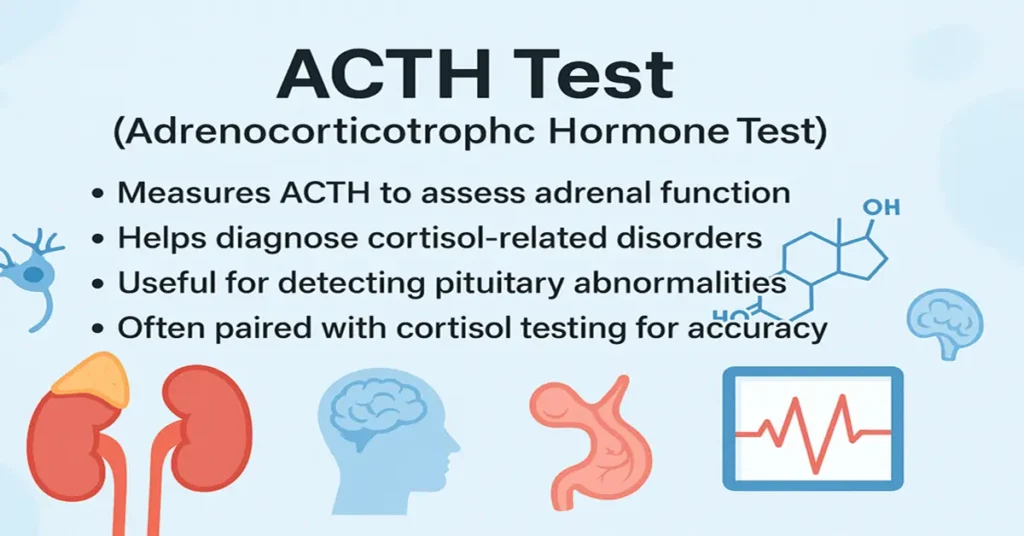
What Is ACTH Test
Why This Test Is Done
The ACTH test measures the level of adrenocorticotropic hormone in the blood. This hormone is produced by the pituitary gland and acts as the main signal that tells the adrenal glands how much cortisol to make. Cortisol is essential for maintaining blood pressure, blood sugar, metabolism, immune balance, and the body’s response to stress.
In routine OPD and hospital practice, doctors order an ACTH test when they suspect a cortisol imbalance, either too low or too high. It is commonly used when patients present with unexplained fatigue, weight changes, blood pressure abnormalities, weakness, or other symptoms that suggest a hormonal problem. Because cortisol plays such a central role in daily functioning and stress handling, understanding ACTH levels helps doctors assess whether the pituitary–adrenal system is working properly.
ACTH is rarely interpreted alone. It is almost always measured alongside cortisol, because the relationship between these two hormones gives far more useful information than either value by itself. Clinically, this pairing helps doctors decide whether the problem lies in the pituitary gland or in the adrenal glands.
Biological Role and Functions of ACTH
ACTH is a peptide hormone produced by the anterior pituitary gland. Its primary function is to stimulate the adrenal cortex to produce cortisol. Cortisol then acts on multiple organs to regulate metabolism, maintain blood pressure, control inflammation, and help the body respond to physical and emotional stress.
This process is part of the hypothalamic–pituitary–adrenal (HPA) axis. When the brain senses stress, illness, injury, or low blood sugar, it signals the pituitary to release ACTH. ACTH travels through the bloodstream to the adrenal glands, prompting them to release cortisol. Once cortisol levels rise adequately, feedback signals reduce ACTH release, keeping the system balanced.
ACTH also supports the production of adrenal androgens and helps maintain normal adrenal gland structure. Because ACTH follows a daily rhythm, with highest levels in the early morning and lowest levels at night, timing of the blood sample is critical for accurate interpretation.
Medical Importance of Measuring This Parameter
Measuring ACTH is medically important because disorders of cortisol regulation can be serious if not identified early. Even modest abnormalities in this hormone system can produce significant symptoms over time.
One of the most important uses of the ACTH test is in evaluating adrenal insufficiency. When cortisol levels are low, ACTH testing helps determine whether the adrenal glands themselves are failing or whether the pituitary gland is not producing enough ACTH. This distinction directly affects management decisions.
ACTH testing is also central to evaluating excess cortisol states. High ACTH levels may indicate pituitary overproduction or ACTH secretion from non-pituitary tumors. In routine lab practice, this information helps guide further testing such as imaging or specialized hormone studies.
Doctors may also use ACTH measurements when adjusting long-term steroid therapy or when monitoring recovery of adrenal function after prolonged steroid use.
Conditions Diagnosed Using This Test
The ACTH test supports the diagnosis and evaluation of several endocrine conditions.
Addison’s disease
In this condition, the adrenal glands cannot produce enough cortisol. ACTH levels are usually high because the pituitary is trying to stimulate poorly functioning adrenal glands. Symptoms often include fatigue, low blood pressure, weight loss, and salt craving.
Secondary adrenal insufficiency
Here, the problem lies in the pituitary gland. Low ACTH leads to low cortisol production. Symptoms may resemble Addison’s disease but usually without skin darkening.
Cushing’s disease
A pituitary tumor produces excess ACTH, leading to persistently high cortisol levels. Patients may develop weight gain, muscle weakness, high blood pressure, and skin changes.
Ectopic ACTH syndrome
Certain tumors outside the pituitary gland can produce ACTH. This causes very high ACTH levels and rapid cortisol excess, often with quickly worsening symptoms.
Congenital adrenal hyperplasia
Some forms of this condition interfere with cortisol production, causing ACTH levels to rise as the pituitary attempts to compensate.
Stress-related hormonal changes
Severe illness, trauma, or stress can temporarily alter ACTH levels. In these cases, testing helps determine whether the change is appropriate or due to underlying disease.
Limitations of the Test
The ACTH test has important limitations that doctors consider during interpretation. ACTH is a fragile hormone that breaks down easily, so blood samples must be handled quickly and correctly. Improper handling can lead to falsely low results.
Another key limitation is normal daily variation. ACTH levels peak in the morning and drop later in the day. Testing at the wrong time can give misleading values.
ACTH levels alone cannot confirm a diagnosis. They must always be interpreted along with cortisol levels, symptoms, medical history, and often additional tests such as stimulation or suppression studies. Medications, stress, and acute illness can also influence results, which is why repeat testing is sometimes needed.
Additional Information
ACTH testing is often part of a broader endocrine evaluation rather than a one-time investigation. In patients with unclear or fluctuating symptoms, repeated measurements help identify patterns rather than relying on a single value.
In clinical practice, ACTH results may guide decisions such as adjusting steroid doses, planning imaging of the pituitary or adrenal glands, or determining the need for specialized endocrine referral.
Test Preparation
ACTH testing is usually done early in the morning, typically between 7 AM and 10 AM, to match the hormone’s natural rhythm. Patients may be advised to avoid strenuous exercise and emotional stress before the test. Fasting is not always required, but specific instructions depend on the tests being ordered together.
It is important to inform the doctor about current or recent steroid use, as these medications can significantly affect ACTH levels.
When to See a Doctor
Medical evaluation is recommended for persistent fatigue, unexplained weight changes, dizziness, blood pressure abnormalities, or symptoms suggesting cortisol imbalance. Sudden or severe symptoms such as fainting, extreme weakness, confusion, or unusual skin changes require prompt attention.
People with known pituitary or adrenal disorders, or those on long-term steroid therapy, should have regular follow-up and never stop medication without medical guidance.
Sample Type
The ACTH test uses a blood sample drawn from a vein. Because the hormone degrades quickly, the sample must be processed rapidly and kept cold. In selected cases, multiple samples may be taken to assess hormone variation.
Important Word Explanations
ACTH: A hormone produced by the pituitary gland that stimulates cortisol production.
Cortisol: A hormone essential for metabolism, blood pressure, and stress response.
Pituitary gland: A small gland in the brain that controls many hormonal functions.
Adrenal glands: Glands located above the kidneys that produce cortisol and other hormones.
Adrenal insufficiency: A condition in which the body cannot produce enough cortisol.
People Also Ask
Is the ACTH test a routine blood test?
It is not routine. It is ordered when doctors suspect a cortisol or pituitary–adrenal problem.
Can ACTH levels change temporarily?
Yes. Stress, illness, and medications can cause short-term changes.
Does an abnormal ACTH result always mean disease?
No. Results must be interpreted with cortisol levels and clinical findings.
When do doctors worry most about ACTH results?
Concern increases when abnormal values persist and match symptoms of cortisol imbalance.
Is repeat testing common for ACTH?
Yes. Repeat testing is often done to confirm results and observe trends.
~END~