
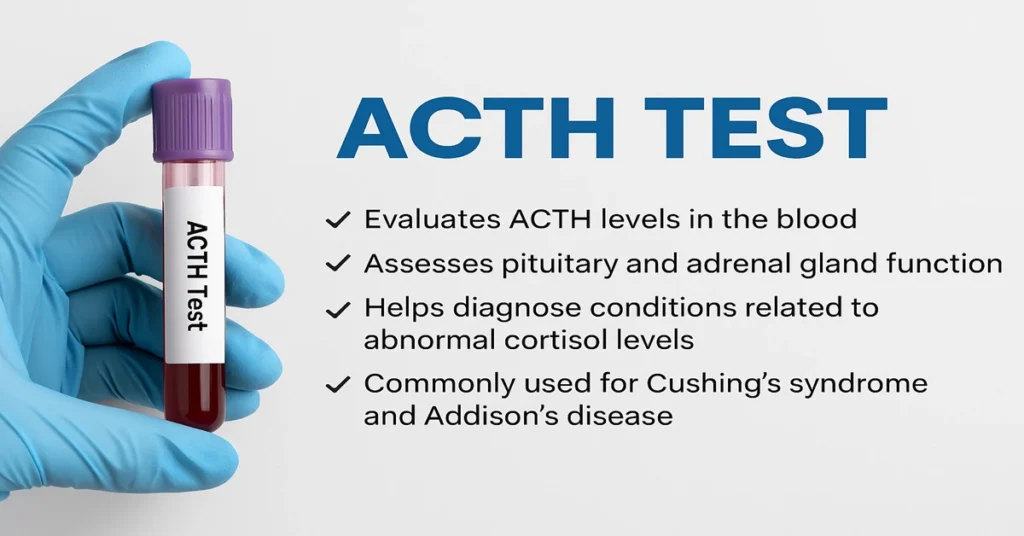
What is ACTH?
ACTH, or Adrenocorticotropic Hormone, is a hormone produced by the pituitary gland, a small but powerful gland located at the base of the brain. Its primary role is to stimulate the adrenal glands, which sit above the kidneys, to produce cortisol — the body’s main stress-related hormone.
From a laboratory perspective, ACTH is a regulatory hormone. It does not act alone, but works as part of a tightly controlled system that links the brain and adrenal glands. Measuring ACTH in the blood helps doctors understand whether symptoms are coming from the pituitary gland, the adrenal glands, or the communication pathway between them.
The ACTH test is therefore used to evaluate disorders of the hypothalamic–pituitary–adrenal (HPA) axis, especially when cortisol levels are abnormal.
Where is ACTH Produced in the Body?
ACTH is produced by the anterior pituitary gland (also called the adenohypophysis). Its release is controlled by the hypothalamus, a region of the brain that monitors stress, sleep–wake cycles, and metabolic needs.
The hypothalamus releases Corticotropin-Releasing Hormone (CRH), which signals the pituitary to produce ACTH. ACTH then travels through the bloodstream to the adrenal glands, prompting them to release cortisol.
This three-step feedback loop — hypothalamus → pituitary → adrenal glands — is known as the HPA axis. Cortisol produced by the adrenal glands feeds back to the brain and pituitary to regulate how much ACTH is released, keeping the system in balance.
Main Functions and Importance of ACTH
ACTH plays a central role in hormonal regulation, even though its effects are indirect.
Its most important function is stimulating cortisol production in the adrenal cortex. Cortisol influences how the body responds to stress, illness, injury, and daily metabolic demands.
Through cortisol, ACTH helps regulate the use of carbohydrates, fats, and proteins for energy. It also contributes to maintaining blood pressure, supporting immune balance, and controlling inflammation.
ACTH secretion follows a circadian rhythm. Levels are highest in the early morning and lowest late at night. This natural pattern is important when interpreting test results, which is why timing of sample collection matters.
Clinically, ACTH measurement helps distinguish whether a hormonal imbalance is driven by the pituitary, the adrenal glands, or an external influence.
Causes of Low ACTH Levels
Low ACTH levels usually reflect reduced pituitary signaling or suppression caused by excess cortisol.
This can occur when the adrenal glands themselves are producing too much cortisol, which feeds back to suppress ACTH release. Long-term use of external corticosteroids can have a similar suppressive effect on the pituitary.
Damage or dysfunction of the pituitary gland may also reduce ACTH production. In laboratory practice, low ACTH is always interpreted alongside cortisol levels to understand the direction of hormonal control.
Symptoms of Low ACTH Levels
Symptoms associated with low ACTH are usually related to excess cortisol activity or pituitary dysfunction, rather than ACTH itself.
These may include ongoing fatigue, changes in body fat distribution, elevated blood pressure, mood changes, or hormonal effects such as altered hair patterns. The clinical picture varies depending on the underlying cause and duration of imbalance.
Causes of High ACTH Levels
High ACTH levels indicate that the pituitary or hypothalamus is strongly signaling the adrenal glands.
This most commonly happens when the adrenal glands are unable to produce enough cortisol, leading the body to increase ACTH output in an attempt to compensate. It may also occur when the pituitary itself produces ACTH autonomously.
In some situations, ACTH can be produced outside the pituitary by certain tumors, leading to inappropriate hormone elevation. Severe physical stress or acute illness can also cause temporary increases in ACTH as part of the normal stress response.
Symptoms of High ACTH Levels
Symptoms related to high ACTH levels reflect either cortisol deficiency or cortisol excess, depending on adrenal response.
In cortisol deficiency states, increased ACTH may be associated with skin darkening, fatigue, weight loss, low blood pressure, nausea, or salt craving. When ACTH drives excess cortisol production, features such as central weight gain, facial rounding, skin changes, or muscle weakness may be seen.
The symptom pattern provides important clinical clues but must always be interpreted with hormone measurements.
Reference Ranges
ACTH levels vary by laboratory and are strongly influenced by the time of collection.
Typical reference ranges for fasting morning samples (around 8 AM) are approximately:
- 10–60 pg/mL (or 2.2–13.2 pmol/L)
Levels are lower later in the day due to normal diurnal variation. For this reason, morning sampling is preferred for accurate interpretation and comparison.
Sample Type and Handling
ACTH testing requires careful sample handling because the hormone is unstable.
The test is performed on plasma, not serum. Blood is collected in an EDTA (purple-top) tube. The sample must be kept cold and processed promptly to prevent hormone degradation.
Strict pre-analytical handling is essential, and this is one reason ACTH testing is often performed in specialized laboratories.
How is the ACTH Test Performed?
A blood sample is drawn from a vein, usually from the arm.
The sample is immediately placed in an EDTA tube, kept on ice, and rapidly transported to the laboratory. Plasma is separated and analyzed for ACTH concentration using sensitive immunoassay techniques.
ACTH testing is often performed alongside a cortisol test, as interpreting one without the other can be misleading.
Interpreting ACTH Test Results
ACTH results are never interpreted in isolation. The relationship between ACTH and cortisol is key.
- Low ACTH with high cortisol suggests adrenal-driven cortisol excess or steroid suppression
- High ACTH with high cortisol points toward pituitary-driven cortisol excess
- High ACTH with low cortisol indicates primary adrenal failure
- Low ACTH with low cortisol suggests pituitary or hypothalamic dysfunction
Trend patterns, clinical symptoms, and imaging studies often guide final diagnosis.
Test Preparation
Blood collection is usually scheduled for early morning, ideally between 8 and 9 AM.
Patients are advised to minimize stress before sampling, as stress can transiently raise ACTH levels. Steroid medications may influence results and should be disclosed to the clinician.
Fasting is generally not required unless combined with other hormone tests.
When to Consult a Doctor
Medical evaluation is recommended if symptoms such as persistent fatigue, unexplained weight changes, skin darkening, frequent dizziness, low blood pressure, or mood changes are present.
ACTH testing is particularly helpful when cortisol results are abnormal or inconsistent with symptoms. Doctors often assess both hormones together to gain a complete picture of adrenal and pituitary function.
Important Word Explanations
- Pituitary gland: A small gland at the base of the brain that regulates many hormones
- Adrenal glands: Glands above the kidneys that produce cortisol and stress hormones
- Cortisol: A hormone that regulates stress response, metabolism, and blood pressure
- Hypothalamus: Brain region that controls pituitary hormone release
- HPA Axis: The communication pathway between hypothalamus, pituitary, and adrenal glands
- Cushing’s Disease: Excess cortisol due to pituitary overproduction of ACTH
- Addison’s Disease: Cortisol deficiency due to adrenal gland failure
~END~