
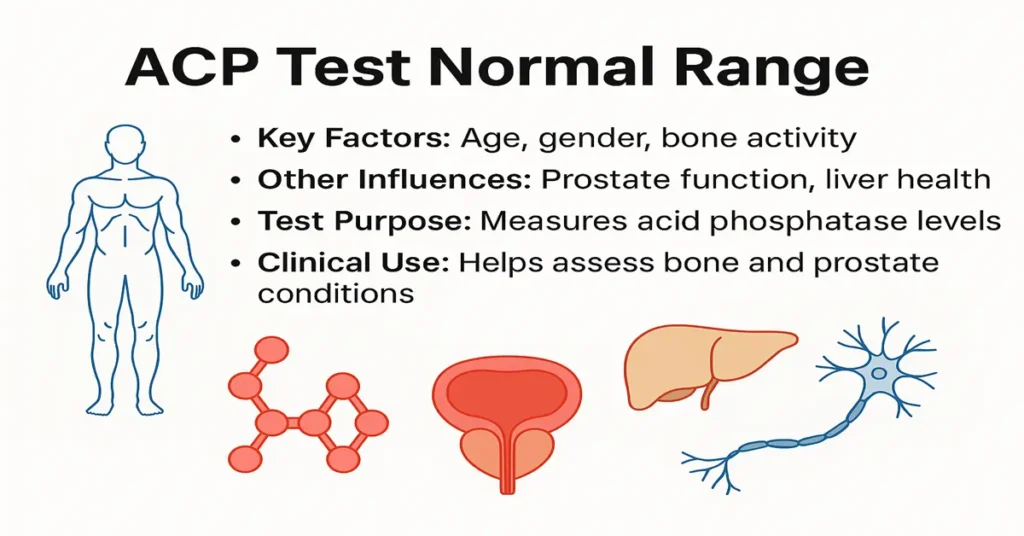
Normal Range of ACP Test
Why Normal Range Matters
Any laboratory test becomes meaningful only when the result is compared with an accepted normal range. The ACP test measures the level of acid phosphatase enzyme in the blood, an enzyme produced by several tissues such as the prostate, liver, spleen, bones, and certain blood cells.
In routine lab practice, the normal range acts as a reference point. It helps doctors judge whether the enzyme level reflects normal tissue activity or whether there may be increased cell breakdown, inflammation, or abnormal tissue turnover somewhere in the body. A value outside the normal range does not automatically mean disease. Clinically, it simply tells the doctor that the result needs to be correlated with symptoms, history, and other investigations.
Normal ranges also matter because ACP values are influenced by age, gender, and physiological state. Knowing what is expected for a particular person prevents over-interpretation and unnecessary concern.
General Reference Range
The reference range for acid phosphatase can vary slightly depending on the laboratory method and reagents used. However, most clinical laboratories report a broadly similar range for total ACP.
Typical reference range (total acid phosphatase):
0.5 to 2.5 U/L
This range applies to most healthy adults. Results slightly outside this range are interpreted cautiously, especially if the patient has no symptoms.
Some laboratories also report prostatic acid phosphatase (PAP) separately. PAP levels are normally very low, and elevations are interpreted only in the context of prostate-related evaluation.
Doctors always rely on the reference range printed on the lab report rather than memorized numbers, because methodology matters.
Age-Wise Normal Range
Age can influence ACP values, mainly because bone activity changes throughout life.
Children
Children often show higher ACP levels than adults. This is usually related to active bone growth and remodeling. Depending on age and laboratory standards, values may extend higher than adult ranges and still be considered normal.
Adults
In adults, bone turnover stabilizes, and ACP values usually fall within the standard adult reference range of 0.5 to 2.5 U/L. This is the group where interpretation is most straightforward.
Older individuals
With aging, mild changes in bone metabolism and tissue activity can occur. A small rise may still be within expected limits, but persistent or marked elevations are evaluated further, especially if symptoms are present.
In clinical practice, age alone rarely explains a major abnormality, but it provides helpful background context.
Gender-Wise Normal Range
Gender-related differences exist mainly because the prostate contributes to ACP production.
Men
Men may naturally have ACP values toward the higher end of the adult reference range due to the prostate gland. Most healthy men still fall within 0.5 to 2.5 U/L.
Women
Women typically have slightly lower ACP levels because they do not have a prostate. Their values usually fall within the same overall range but tend to cluster toward the lower end.
These differences are subtle, and doctors rely more on laboratory reference limits than on gender alone.
Pregnancy-Specific Normal Range
Pregnancy does not usually cause significant changes in acid phosphatase levels. In most cases, the standard adult reference range still applies.
If ACP values are abnormal during pregnancy, doctors look for causes unrelated to pregnancy itself, such as bone conditions, liver involvement, or blood cell breakdown. There are no widely accepted pregnancy-specific ACP reference ranges, so interpretation is always cautious and clinically guided.
Factors That Affect Test Values
Several factors can influence ACP levels and explain why results may appear outside the normal range.
Bone metabolism and growth
Conditions involving increased bone turnover, fractures, or healing processes can raise ACP levels.
Prostate activity
In men, prostate-related conditions may increase prostatic acid phosphatase. Although PSA is more commonly used today, ACP may still provide supportive information.
Liver and spleen involvement
Inflammation, infection, or metabolic stress affecting these organs can alter ACP levels.
Hemolysis
Increased breakdown of blood cells can temporarily raise enzyme levels in the bloodstream.
Physical activity
Strenuous exercise before testing may influence enzyme readings and should be avoided.
Medications
Drugs affecting bone metabolism, cellular turnover, or liver function can shift ACP values.
Sample handling
ACP is a sensitive enzyme. Delayed processing or improper storage can lead to falsely high or low results, which is why repeat testing is sometimes needed.
Understanding these factors helps doctors avoid misinterpretation of a single value.
Additional Information
Although ACP testing is used less frequently today, especially for prostate screening, it still has relevance in selected diagnostic situations. Modern tests like PSA have largely replaced PAP, but ACP remains useful when evaluating bone activity, metabolic conditions, or unexplained enzyme abnormalities.
Normal ranges are only the starting point. Doctors always combine ACP results with symptoms, imaging, and other laboratory findings. A single abnormal value is rarely enough to draw conclusions, and repeat testing is common when results are unexpected.
Test Preparation
No special preparation is usually required for the ACP test. Normal eating and drinking are allowed unless other tests in the same panel require fasting.
It is advisable to inform the healthcare provider about medications, supplements, recent injuries, or fractures. Avoiding heavy physical activity before the test helps ensure accurate results.
When to See a Doctor
Medical advice is recommended if ACP levels remain consistently outside the normal range or if symptoms such as bone pain, unexplained fatigue, urinary issues, or weakness are present. People with known bone, liver, or prostate conditions should also discuss any abnormal trends with their doctor.
Clinical evaluation helps determine whether the finding reflects a temporary variation or an underlying condition that needs monitoring.
Sample Type
The ACP test is performed using a blood sample drawn from a vein in the arm. Laboratories may measure total acid phosphatase and, in specific cases, prostatic acid phosphatase separately, depending on the clinical indication.
Important Word Explanations
Reference range: The expected normal values used to interpret a lab test.
Enzyme: A protein that supports chemical reactions in the body.
Bone turnover: The natural cycle of bone breakdown and rebuilding.
Prostatic acid phosphatase (PAP): A form of ACP produced by the prostate gland.
Hemolysis: Breakdown of red blood cells.
People Also Ask
Is being slightly outside the normal ACP range serious?
Usually not. Mild changes often have no clinical significance.
Can ACP values change temporarily?
Yes. Injury, exercise, illness, or medications can cause short-term variation.
Does an abnormal ACP level always mean disease?
No. Many non-disease factors can influence the result.
When do doctors usually worry about ACP levels?
Concern increases when abnormal values persist and match symptoms or other test findings.
Is repeat testing common for ACP?
Yes. Repeat testing is often done to confirm whether the change is real or temporary.
~END~