
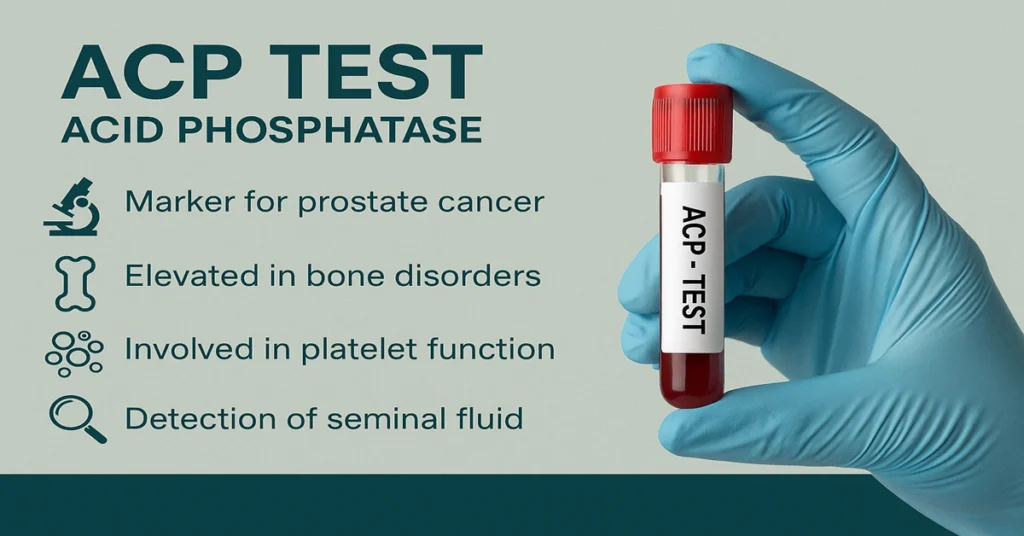
What is ACP (Acid Phosphatase)?
ACP, or Acid Phosphatase, is an enzyme that helps break down phosphate-containing compounds in an acidic environment. It is present in several tissues throughout the body, but the highest concentrations are found in the prostate gland, particularly in men.
Historically, ACP testing played an important role in the diagnosis of prostate cancer. With the development of more specific markers such as PSA (Prostate-Specific Antigen), its role has shifted. Today, ACP testing is mainly used as a supportive or follow-up marker in selected clinical situations, especially in advanced prostate disease, certain bone disorders, platelet-related conditions, and rare metabolic storage diseases.
From a laboratory perspective, ACP is best viewed as a context-dependent marker—useful when interpreted alongside clinical findings and other investigations.
Where is ACP Produced in the Body?
Acid phosphatase is produced by several tissues, each contributing a small fraction to total enzyme activity measured in blood.
The prostate gland is the most significant source in men and is responsible for the prostatic fraction of ACP. Other contributing tissues include the liver and spleen, where ACP reflects general cellular turnover, as well as red blood cells and platelets. Bone tissue, particularly osteoclasts involved in bone breakdown, also releases ACP during active bone remodeling.
Because ACP originates from multiple sites, elevated levels are never interpreted in isolation and always require clinical correlation.
Main Functions and Importance of ACP
ACP does not have a single dominant physiological role in daily body function, but it has several important clinical and diagnostic applications.
In prostate disease, especially advanced or metastatic prostate cancer, ACP levels may rise as prostate cells release the enzyme into circulation. Although PSA has largely replaced ACP for early detection, ACP still provides useful information in monitoring disease progression or response in selected cases.
In bone disorders, ACP activity may increase when there is excessive bone breakdown, reflecting osteoclast activity. This is sometimes seen in metabolic bone diseases or bone involvement from malignancy.
ACP is also present in platelets and contributes indirectly to platelet-related processes, which is why abnormal platelet counts can influence ACP levels.
Within cells, ACP functions as a lysosomal enzyme, participating in the breakdown and recycling of cellular material—an aspect that becomes relevant in certain storage disorders.
Outside routine clinical medicine, ACP has a well-established role in forensic science, where high prostatic ACP activity helps identify seminal fluid in investigative settings.
Causes of Low ACP Levels
Low ACP levels are generally not considered clinically significant.
They are most often seen after successful treatment of prostate cancer, reflecting reduced prostate enzyme release. Reduced platelet numbers can also be associated with lower ACP activity, since platelets contribute to circulating enzyme levels.
In most cases, low ACP is an incidental laboratory finding rather than a diagnostic concern.
Symptoms of Low ACP Levels
Low ACP levels themselves do not produce symptoms. When present, they usually reflect recovery from an underlying condition rather than a disease process.
Causes of High ACP Levels
Elevated ACP levels suggest increased enzyme release from one or more tissues.
Marked elevations are most classically associated with advanced or metastatic prostate cancer, particularly when cancer has spread beyond the prostate.
Bone-related causes include conditions with increased bone breakdown, where osteoclast activity is high. Certain metabolic storage disorders, such as Gaucher’s disease, can also raise ACP due to increased lysosomal activity.
Platelet-related disorders, especially those with increased platelet numbers, may contribute to higher ACP readings. In non-clinical settings, elevated ACP activity is used to identify seminal fluid because of the enzyme’s high concentration in prostatic secretions.
Symptoms of High ACP Levels
ACP itself does not cause symptoms. Any clinical features arise from the underlying condition responsible for the elevation.
When prostate disease is involved, symptoms may relate to urinary flow changes or bone discomfort if there is skeletal involvement. In bone disorders, pain, deformity, or fractures may be present. In metabolic storage diseases, systemic features such as organ enlargement or fatigue may be noted.
Reference Ranges of ACP
Reference ranges vary depending on laboratory method and whether total ACP or the prostatic fraction is measured.
In adults, total ACP typically falls within a low unit range, while the prostatic fraction in men is expected to remain below defined cutoffs. Values above these limits raise suspicion for prostate or bone-related pathology and are interpreted in conjunction with PSA levels, imaging, and clinical findings.
Sample Type and Test Requirements
ACP testing is performed on a serum blood sample, collected in a plain red-top tube.
No fasting is required. However, recent prostate manipulation—including digital rectal examination, biopsy, or ejaculation—can temporarily raise ACP levels and should be avoided before testing when possible.
Test Procedure
A routine blood sample is collected from a vein and processed to separate serum. The laboratory then measures acid phosphatase enzyme activity.
When clinically indicated, the prostatic fraction of ACP may be analyzed separately to improve specificity for prostate-related disease.
Interpretation of Results
Normal ACP levels suggest stable enzyme activity with no major tissue release.
Mild elevations may be seen in bone or platelet-related conditions and usually require correlation with other findings.
Markedly elevated levels raise concern for advanced prostate disease or significant bone involvement, but confirmation always relies on additional tests such as PSA, imaging studies, or histopathology.
Test Preparation
No special preparation is needed beyond avoiding recent prostate manipulation and strenuous physical activity.
Patients should inform their doctor about current medications or supplements, as well as any recent procedures that could influence results.
When to Consult a Doctor
Medical evaluation is advised if ACP elevation is accompanied by urinary symptoms, persistent bone pain, unexplained fatigue, or weight loss.
Patients with known prostate or bone disorders may undergo ACP testing as part of ongoing monitoring, under specialist guidance.
Important Word Explanations
- Enzyme: A protein that accelerates chemical reactions in the body
- Phosphate Ester: A compound involved in cellular energy and metabolism
- Prostate Gland: A male reproductive gland that produces seminal fluid
- Lysosomes: Cellular structures that digest waste and recycled material
- Paget’s Disease: A disorder of abnormal bone breakdown and rebuilding
- Gaucher’s Disease: A genetic condition affecting lysosomal function in organs and bones
~END~