
Overview
The ACHR (Acetylcholine Receptor) Antibody Test is a specialized blood test used to detect antibodies that mistakenly target acetylcholine receptors on muscle cells. These antibodies are most commonly associated with Myasthenia Gravis (MG), an autoimmune condition that leads to fluctuating muscle weakness.
From a clinical standpoint, this test helps doctors confirm whether muscle weakness is caused by an immune-mediated problem at the neuromuscular junction. It is widely used in diagnosis and follow-up, and its results are always interpreted alongside symptoms and neurological findings rather than in isolation.
What is ACHR (Acetylcholine Receptor Antibody)?
ACHR antibodies are autoantibodies, meaning they are produced by the immune system against the body’s own structures. In this case, the target is the acetylcholine receptor, which plays a critical role in normal muscle contraction.
Under healthy conditions, acetylcholine released from nerves binds to these receptors and triggers muscle movement. In Myasthenia Gravis, ACHR antibodies interfere with this process by reducing the number or function of available receptors. As a result, nerve signals reach the muscle less effectively, leading to weakness that typically worsens with repeated use.
The ACHR antibody test measures these antibodies in the blood and helps establish whether this immune mechanism is present.
Where is ACHR Found or Produced in the Body?
Location of receptors:
Acetylcholine receptors are located on the muscle cell surface at the neuromuscular junction, the precise point where motor nerves communicate with skeletal muscles.
Production of antibodies:
The antibodies themselves are produced by B lymphocytes, a type of immune cell. In autoimmune conditions such as Myasthenia Gravis, these cells become misdirected and generate antibodies against acetylcholine receptors instead of protecting the body from infections.
Functions and Importance of the ACHR Test
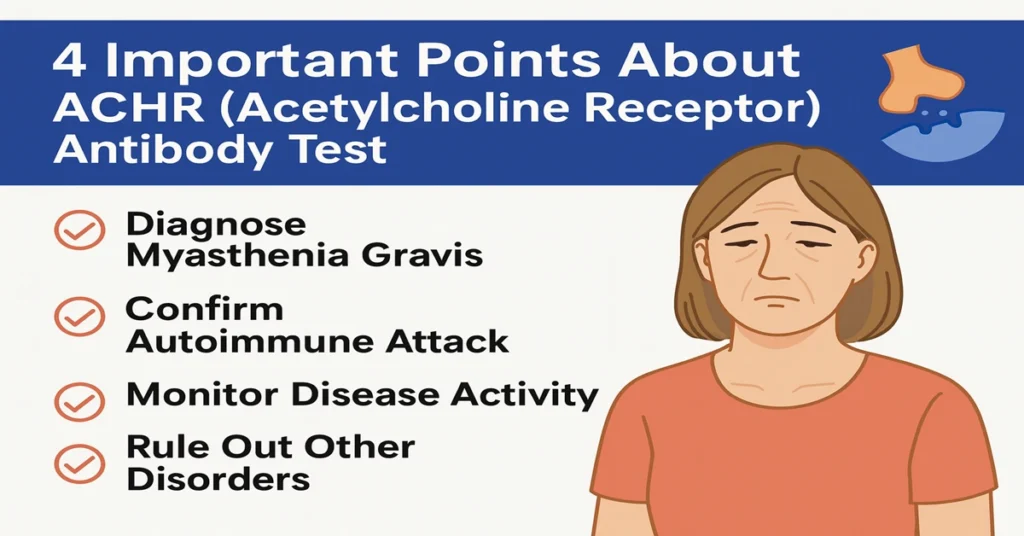
The ACHR antibody test has several important clinical uses:
Diagnosis of Myasthenia Gravis:
The primary role of the test is to confirm whether muscle weakness is autoimmune in origin. A positive result, when matched with typical symptoms, strongly supports a diagnosis of MG.
Classification of antibody patterns:
ACHR antibodies are commonly grouped into binding, blocking, and modulating types. These patterns help clinicians understand how receptor function is being affected and provide insight into disease behavior.
Monitoring disease activity:
In patients already diagnosed with MG, antibody levels may be followed over time to support clinical assessment, especially when symptoms change.
Differentiation from other neuromuscular disorders:
The test assists in distinguishing MG from conditions such as Lambert-Eaton syndrome or primary muscle diseases, which involve different mechanisms.
Causes of Low or Negative ACHR Antibody Levels
Low or undetectable ACHR antibody levels are seen in several situations:
In healthy individuals, absence of these antibodies is expected.
Some patients with clear clinical features of Myasthenia Gravis have seronegative MG, meaning ACHR antibodies are not detectable despite typical symptoms.
In very early disease, antibody levels may still be below detection limits.
A negative result does not automatically exclude MG and must be interpreted in the clinical context.
Symptoms Associated with Low/Negative ACHR Levels
Healthy individuals with negative results have no symptoms related to ACHR antibodies.
In seronegative MG, patients may still experience classic symptoms such as eyelid drooping, double vision, or muscle fatigue. In such cases, doctors often proceed with additional antibody tests or electrophysiological studies.
Causes of High ACHR Antibody Levels
Elevated ACHR antibody levels indicate an active autoimmune response affecting the neuromuscular junction.
Myasthenia Gravis:
This is the most common cause, with the majority of patients showing detectable antibodies.
Thymic abnormalities:
The thymus gland plays a role in immune regulation, and thymoma or thymic hyperplasia is frequently associated with MG and higher antibody production.
Other autoimmune conditions:
Rarely, low-level elevations may be seen in other autoimmune disorders, although this is uncommon and usually not the primary finding.
Symptoms of High ACHR Antibody Levels (Myasthenia Gravis)
High antibody levels themselves do not cause symptoms, but they reflect the immune process responsible for MG. Typical clinical features include muscle weakness that fluctuates during the day and worsens with activity.
Common manifestations involve the eye muscles, facial muscles, and those used for chewing, speaking, and swallowing. In some cases, respiratory muscles may also be affected, which requires careful medical assessment.
A key clinical feature doctors look for is improvement of strength after rest, which helps distinguish MG from other muscle disorders.
Reference Ranges for ACHR Antibody Test
Reference ranges vary slightly between laboratories, but results are commonly interpreted as:
- Negative: Below the established cutoff, suggesting no detectable autoimmune activity
- Borderline or equivocal: Low-level presence that requires correlation or repeat testing
- Positive: Levels above the cutoff, strongly supportive of Myasthenia Gravis when symptoms are consistent
Trends over time and clinical correlation are more important than a single number.
Sample Type and Testing Method
- Sample type: Serum
- Collection tube: Red-top (plain) tube
- Testing method: Radioimmunoassay (RIA) or ELISA
Fasting is not required, and results are usually available within a few days, depending on laboratory setup.
Test Preparation
No specific preparation is needed before testing.
Patients should inform their doctor about ongoing immunosuppressive therapy or recent infections, as these factors can influence antibody levels. In diagnosed cases, repeat testing may be scheduled to support long-term clinical monitoring.
When to Consult a Doctor
Medical consultation is important if a person experiences persistent or unexplained muscle weakness, especially when it fluctuates with activity or involves the eyes, face, or throat.
If ACHR antibodies are negative but symptoms continue, further neurological evaluation is often recommended to explore other antibody types or neuromuscular studies.
Important Word Explanations
- Autoantibody: An antibody that mistakenly targets the body’s own tissues
- Neuromuscular Junction: The connection point between a nerve and a muscle
- Myasthenia Gravis (MG): An autoimmune disorder causing fluctuating muscle weakness
- Thymoma: A tumor of the thymus gland, often associated with MG
- Seronegative MG: MG with typical symptoms but no detectable ACHR antibodies
~END~