
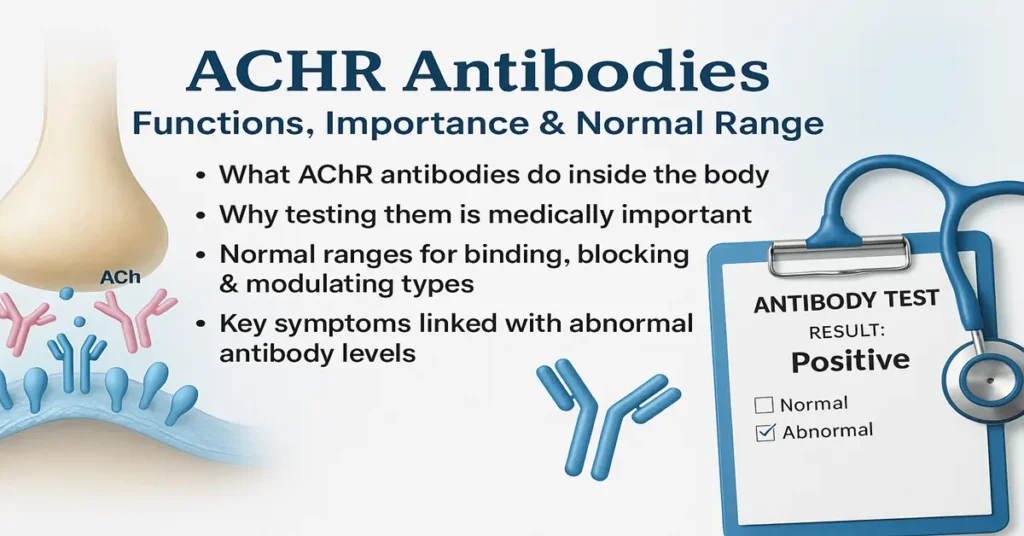
Functions, Importance, and Normal Range of AChR Antibodies
Understanding What AChR Antibodies Are
Acetylcholine receptor antibodies, commonly known as AChR antibodies, are immune proteins produced when the body mistakenly targets acetylcholine receptors as foreign. These receptors sit at the neuromuscular junction, the point where nerves transmit signals that allow muscles to contract. In a healthy immune system, these receptors are left untouched. When AChR antibodies are present, it indicates an abnormal immune response that interferes with nerve–muscle communication.
In day-to-day clinical practice, the AChR antibody test is ordered when symptoms suggest a problem with neuromuscular transmission. Elevated antibodies can block or damage receptors, weakening the signal from nerve to muscle. This is why the test plays a central role in evaluating certain neuromuscular disorders.
Functions of AChR Antibodies
AChR antibodies do not serve a useful purpose in the body. Their “function” reflects immune system misdirection rather than normal physiology. Understanding how they act explains the symptoms doctors observe.
Blocking Acetylcholine Receptors
Some AChR antibodies attach to the receptor and physically block acetylcholine from binding. When this happens, the muscle does not receive a strong enough signal to contract, leading to weakness, especially with repeated use.
Damaging or Reducing Receptors
Other antibodies attract immune components that damage or destroy the receptor. Over time, fewer working receptors remain on the muscle surface, which further weakens muscle response.
Activating Immune Inflammation
Certain AChR antibodies trigger the complement system, an immune pathway that increases local inflammation at the neuromuscular junction. This inflammation further disrupts signal transmission.
These mechanisms together explain why AChR antibodies are closely linked with disorders such as myasthenia gravis.
Importance of Testing AChR Antibodies
Testing AChR antibodies is clinically important because it helps identify immune-related causes of muscle weakness.
Supports Diagnosis of Myasthenia Gravis
Myasthenia gravis is the condition most commonly associated with AChR antibodies. A positive test strongly supports this diagnosis when symptoms fit the clinical pattern.
Helps Differentiate Neuromuscular Conditions
Many conditions cause weakness. The AChR antibody test helps distinguish problems at the neuromuscular junction from muscle diseases or nerve disorders, which guides further evaluation.
Provides Insight Into Immune Activity
In some patients, higher antibody levels suggest more active immune involvement. Clinically, doctors use this information cautiously, as symptom severity does not always match the number.
Assists in Long-Term Monitoring
In selected cases, repeat testing helps track immune trends over time, especially when treatment plans are being adjusted.
Normal Range of AChR Antibodies
Reference ranges depend on the laboratory method used. The following are commonly accepted values used in routine practice.
Binding Antibodies
Normal: usually less than 0.25 nmol/L
Values above this suggest abnormal immune activity at the neuromuscular junction.
Blocking Antibodies
Normal: typically less than 15% inhibition
Higher percentages indicate interference with acetylcholine binding.
Modulating Antibodies
Normal: generally less than 20% receptor loss
Elevated values suggest accelerated receptor breakdown.
Because laboratories may use different techniques, doctors always interpret results using the lab-specific reference range.
Causes of Abnormal AChR Antibody Levels
Abnormal levels usually reflect immune system dysregulation rather than muscle disease.
Autoimmune Activation
The most common cause is an autoimmune response in which the immune system targets acetylcholine receptors.
Thymus Gland Abnormalities
Enlargement of the thymus or thymoma can disturb immune regulation and promote antibody production.
Genetic and Environmental Factors
Some people have genetic susceptibility. Infections, stress, or hormonal shifts may act as triggers in predisposed individuals.
Symptoms Linked With Abnormal AChR Antibody Levels
Symptoms appear when nerve–muscle signaling becomes inefficient.
Muscle Weakness
Weakness typically worsens with activity and improves with rest, a pattern doctors find very characteristic.
Drooping Eyelids and Vision Problems
Eye muscles are commonly affected, leading to eyelid drooping or double vision.
Difficulty Speaking or Swallowing
Facial and throat muscle involvement may cause slurred speech, chewing fatigue, or choking sensations.
Breathing Difficulty in Severe Cases
Weakness of breathing muscles is uncommon but serious and requires urgent care.
Additional Information
AChR antibody levels alone do not predict how severe symptoms will be. In routine lab practice, it is common to see patients with high antibody levels but mild symptoms, and others with moderate levels and significant weakness. Diagnosis and management always rely on combining test results with clinical findings, nerve studies, and imaging when needed.
No lifestyle change or home remedy can alter AChR antibody levels. Because these antibodies arise from autoimmune processes, medical evaluation and supervision are essential.
Test Preparation
No fasting is usually required. Normal eating and drinking are allowed unless advised otherwise. Patients should inform the doctor about immunosuppressive medications, as these can influence interpretation.
When to See a Doctor
Medical evaluation is needed if muscle weakness persists, worsens with activity, or improves with rest. Drooping eyelids, swallowing difficulty, or breathing problems should never be ignored. Sudden worsening of symptoms requires urgent attention.
Sample Type
The test is performed on a blood sample drawn from a vein. Depending on the request, the laboratory measures binding, blocking, or modulating antibodies.
Important Word Explanations
Neuromuscular junction
The connection point where nerves transmit signals to muscles
Thymus gland
An immune organ involved in training immune cells
Autoimmune disorder
A condition in which the immune system attacks healthy tissues
Receptor
A structure on a cell surface that receives chemical signals
Modulating antibodies
Antibodies that reduce the number of functional receptors on muscle cells
People Also Ask
Is a positive AChR antibody result serious?
It can be, but seriousness depends on symptoms and clinical findings, not the number alone.
Can AChR antibody levels be temporary?
Mild elevations may be temporary, but persistent positivity usually needs evaluation.
Does a positive result always mean myasthenia gravis?
Most commonly yes, but doctors confirm it with symptoms and other tests.
When do doctors usually worry about AChR antibodies?
When weakness affects daily activities, swallowing, or breathing.
Is repeat testing of AChR antibodies common?
Sometimes. It may be used to monitor disease trends in selected cases.
Can symptoms occur with normal AChR antibody levels?
Yes. Some patients have symptoms despite negative tests, which is why clinical evaluation is essential.
~END~