
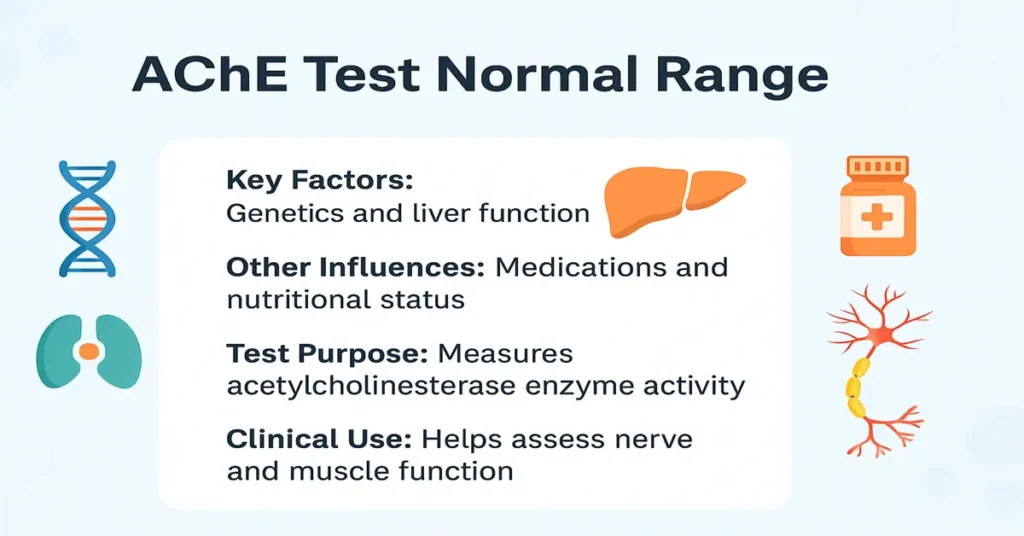
Normal Range of AChE Test
Why Normal Range Matters
Acetylcholinesterase (AChE) is a key enzyme that helps end nerve signals at the right moment by breaking down acetylcholine. In simple terms, it allows muscles and nerves to switch off properly after a signal has passed. Because this process is continuous and precise, doctors rely on the normal range of AChE activity as a reference point to judge whether the nervous system is functioning as expected.
In routine lab and OPD practice, the normal range becomes especially important when evaluating people with suspected pesticide exposure, unexplained neuromuscular symptoms, or unusual reactions to anesthesia. A result within the normal range usually reassures clinicians that enzyme activity is adequate. A result outside that range signals the need to pause, correlate symptoms, and look deeper rather than jumping to conclusions.
The normal range also helps doctors understand how significant a change is. A mild deviation may have little clinical meaning, while a large drop can indicate serious enzyme inhibition. This context-driven interpretation is why the reference range matters as much as the number itself.
General Reference Range
The normal range of AChE activity can vary depending on the laboratory method, equipment, and the type of sample tested. In most routine clinical laboratories, plasma or serum AChE activity commonly falls within:
3500 to 8500 U/L
This range serves as a general guide. In real-world practice, doctors always rely on the reference range printed on the patient’s report, because each lab validates its own limits.
Red blood cell (RBC) AChE values behave differently. They tend to be more stable and reflect longer-term enzyme activity rather than rapid changes. Because testing methods differ widely, RBC AChE does not have a single universal numeric range. Interpretation is always lab-specific.
Clinically, a value well below the lower limit raises concern for enzyme inhibition or deficiency. Values above the upper limit are uncommon and, in most cases, do not carry strong clinical significance on their own.
Age-Wise Normal Range
AChE activity does not change dramatically with age, but some patterns are seen in practice.
Newborns and infants
Enzyme systems are still maturing, so AChE activity may be slightly lower than adult values. This usually normalizes as the nervous system develops.
Children and adolescents
By early childhood, AChE activity generally aligns with adult ranges. Values remain stable unless affected by illness or environmental exposure.
Adults
Adults show the most consistent enzyme activity. For this reason, adult reference ranges are commonly used as the standard baseline.
Older adults
Some older individuals may show mildly reduced activity due to natural metabolic changes or reduced liver reserve. These changes are usually modest and only become meaningful when supported by symptoms or exposure history.
Overall, age-related variation rarely changes clinical decisions by itself. Doctors focus more on trends and clinical context than on age alone.
Gender-Wise Normal Range
Gender-related differences in AChE activity are usually small.
Males
Men may show slightly higher enzyme activity in some studies, but this difference is typically minor and not clinically decisive.
Females
Women may have small variations related to hormonal changes. During pregnancy, dilutional effects from increased blood volume can reduce measured levels.
In day-to-day practice, clinicians depend on the laboratory reference range rather than adjusting interpretation based solely on gender.
Pregnancy-Specific Normal Range
Pregnancy is one situation where AChE levels can shift in a predictable way. Increased plasma volume, hormonal influence, and metabolic changes may lead to moderately lower cholinesterase activity in maternal blood. This is often physiological rather than pathological.
AChE testing also has a distinct role in prenatal diagnostics when measured in amniotic fluid. In that setting, elevated AChE is linked to open neural tube defects. This interpretation applies only to amniotic fluid, not to the mother’s blood. With modern ultrasound and screening tools, this application is now less common, but it remains clinically relevant in selected cases.
During pregnancy, results must always be interpreted cautiously and in coordination with obstetric findings.
Factors That Affect Test Values
Several real-world factors can influence AChE levels and explain why a result may fall outside the expected range.
Exposure to organophosphate or carbamate pesticides
These substances inhibit AChE directly. Even modest exposure can reduce enzyme activity. Severe exposure can cause a marked drop accompanied by clear symptoms.
Genetic variations
Some individuals naturally produce lower levels of active enzyme. These people are often identified only after unusual reactions to anesthesia rather than through routine symptoms.
Liver function
Because cholinesterase enzymes are produced in the liver, liver disease, infections, or certain medications can reduce activity.
Nutritional status and chronic illness
Protein deficiency or prolonged illness can affect enzyme synthesis, leading to lower values.
Medications
Muscle relaxants, certain chemotherapy drugs, and some hormonal therapies can alter enzyme levels.
Acute illness or physiological stress
Severe infections, trauma, or shock may temporarily suppress enzyme activity. In such cases, repeat testing after recovery is common practice.
Understanding these influences prevents over-interpretation of a single abnormal value.
Additional Information
In many clinical settings, AChE testing is paired with plasma cholinesterase testing. Looking at both values together helps doctors distinguish between acute inhibition and inherited enzyme patterns.
After significant enzyme inhibition, recovery is slow. AChE levels may take weeks to return toward normal, and repeat testing is used to follow trends rather than expecting rapid normalization.
The test is not meant for general neurological screening. Its strength lies in targeted situations such as suspected poisoning, anesthesia-related concerns, and specific genetic assessments.
Test Preparation
No special preparation is usually required. Normal eating and drinking are allowed unless otherwise advised.
Patients should inform their doctor about recent pesticide exposure, medications taken in the last few days, any recent anesthesia, and known medical conditions. This background information is often as important as the test result itself.
When to See a Doctor
Immediate medical attention is needed if symptoms suggest significant AChE inhibition, especially after chemical exposure. These include sudden muscle weakness, breathing difficulty, excessive sweating or saliva, confusion, or severe abdominal symptoms.
For non-emergency concerns, evaluation is advised for prolonged recovery after anesthesia, unexplained muscle fatigue, or a known family history of enzyme abnormalities. Early assessment helps avoid misinterpretation and unnecessary worry.
Sample Type
The AChE test is most commonly performed on a blood sample drawn from a vein. RBC-based measurements reflect longer-term activity, while plasma levels change more quickly and are useful in acute settings. Amniotic fluid testing is limited to specific prenatal evaluations.
Important Word Explanations
Acetylcholinesterase (AChE): An enzyme that ends nerve signals by breaking down acetylcholine.
Organophosphate: A class of pesticides that inhibit AChE activity.
Reference Range: The expected value range derived from healthy individuals.
Enzyme Inhibition: Reduction or blocking of normal enzyme activity.
Amniotic Fluid: The fluid surrounding the fetus during pregnancy.
People Also Ask
Is a value outside the normal range always dangerous?
No. Many mild changes are temporary or related to non-serious factors.
Can AChE levels change over time?
Yes. Levels can change with recovery from illness, exposure, or physiological stress.
Does a low AChE value always mean poisoning?
Not always. Genetic variation, liver issues, or medications can also lower levels.
When do doctors usually worry about AChE results?
Concern increases when levels are markedly low and symptoms or exposure history support it.
Is repeat testing common for AChE?
Yes. Doctors often repeat the test to track trends rather than rely on a single result.
~END~