
Introduction
The 17-OHP test (17-Hydroxyprogesterone test) is an important hormonal investigation used to evaluate how the adrenal glands and reproductive organs are functioning. 17-OHP is a naturally occurring steroid hormone produced mainly by the adrenal cortex, with smaller contributions from the ovaries in females and testes in males.
In everyday clinical practice, this test is most often requested when doctors are assessing disorders of adrenal hormone production. Its most well-known role is in the diagnosis of Congenital Adrenal Hyperplasia (CAH), a genetic condition in which normal hormone pathways are disrupted. When interpreted carefully, the 17-OHP level provides valuable insight into adrenal activity and steroid hormone balance.
What is 17-OHP (17-Hydroxyprogesterone)?
17-OHP is a steroid hormone that acts as an intermediate substance in the body’s hormone-production pathway. It sits between progesterone and cortisol, helping the adrenal glands produce cortisol and, indirectly, androgens.
In healthy individuals, 17-OHP is produced and converted efficiently, so blood levels remain within a predictable range. When this pathway is blocked—most commonly due to an enzyme deficiency such as 21-hydroxylase deficiency—17-OHP accumulates in the blood. This accumulation is what makes the test clinically useful.
From a laboratory perspective, 17-OHP is not a sex hormone itself, but it reflects how well adrenal steroid synthesis is functioning.
Where is 17-OHP Produced in the Body?
17-Hydroxyprogesterone is produced primarily in:
- The adrenal cortex, especially in the zones responsible for steroid hormone synthesis
- The gonads, including ovaries in females and testes in males
Within the adrenal glands, 17-OHP is part of the normal cortisol-production pathway:
Cholesterol → Progesterone → 17-OHP → 11-Deoxycortisol → Cortisol
If any step in this sequence is impaired, particularly at the enzyme level, 17-OHP may rise and become detectable in excess amounts in the blood.
Main Functions and Importance of 17-OHP
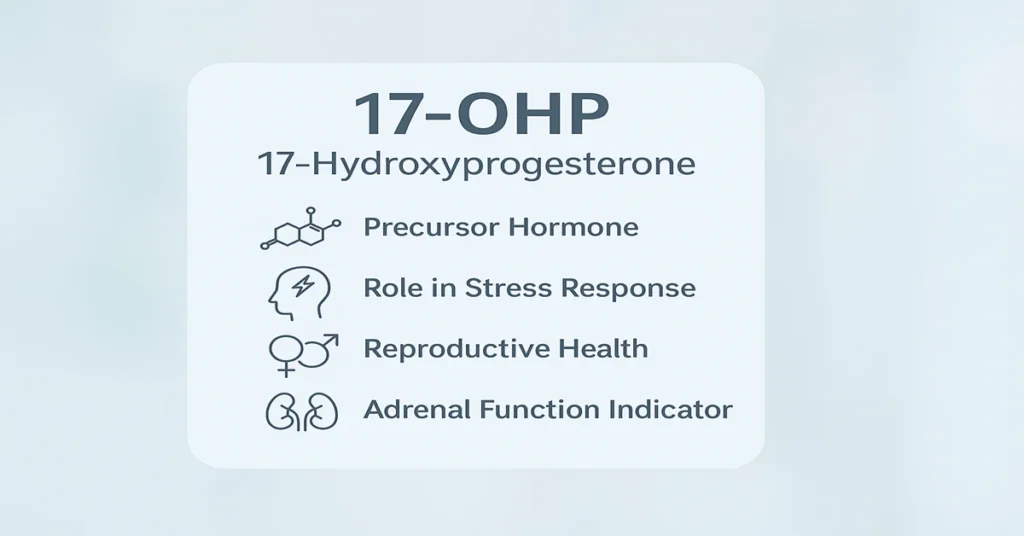
1. Precursor Hormone
17-OHP serves as a building block in the synthesis of cortisol and androgens. Its level reflects how smoothly these pathways are functioning rather than acting as a hormone with strong effects of its own.
2. Role in Stress Response
Because cortisol production depends on this pathway, 17-OHP indirectly relates to the body’s response to stress, illness, and physiological demands.
3. Reproductive Health
Balanced steroid production supports normal reproductive hormone regulation. When 17-OHP levels are abnormal, downstream hormone balance may also be affected, which is why the test is sometimes used in evaluations of menstrual irregularities or fertility concerns.
4. Adrenal Function Indicator
Clinically, 17-OHP is a biochemical marker used to identify adrenal enzyme deficiencies, adrenal hyperplasia, and certain adrenal or gonadal disorders. It is especially important in newborn screening and endocrine evaluations.
Causes of Low Levels of 17-OHP
Low 17-OHP levels are relatively uncommon and are usually interpreted in the context of broader adrenal hormone testing. They may be seen when overall adrenal hormone production is reduced, such as in adrenal insufficiency or reduced pituitary stimulation.
In most individuals, low values alone are not considered clinically significant unless supported by symptoms or other abnormal test results.
Symptoms of Low 17-OHP Levels
Low 17-OHP itself does not cause symptoms. When present, symptoms usually relate to the underlying condition affecting adrenal hormone production, such as reduced stress tolerance, fatigue, or low blood pressure.
Causes of High Levels of 17-OHP
Elevated 17-OHP levels are clinically more meaningful and usually reflect altered adrenal steroid synthesis.
The most common cause is Congenital Adrenal Hyperplasia (CAH), particularly due to 21-hydroxylase deficiency, where cortisol production is impaired and 17-OHP accumulates.
Other situations that may be associated with raised levels include adrenal overactivity, adrenal or gonadal tumors, or hormonal stimulation during stress or illness. Mild elevations may occasionally be seen in conditions associated with increased androgen production.
Symptoms of High 17-OHP Levels
Raised 17-OHP does not cause symptoms by itself. Any symptoms arise from the hormonal imbalance behind the elevation. Depending on age and sex, this may involve features related to androgen excess, altered pubertal timing, menstrual irregularities, or fertility concerns.
In newborns, markedly elevated levels prompt further evaluation for inherited adrenal conditions.
Reference Ranges of 17-OHP
Reference ranges vary by age, sex, and laboratory method. Typical patterns include:
- Higher levels in newborns shortly after birth, followed by a natural decline
- Lower, stable levels in children and adults
- Cyclical variation in adult females depending on the menstrual phase
Significantly elevated values—well above age-appropriate ranges—raise suspicion for enzyme deficiencies such as CAH and require endocrine correlation.
Sample Type
- Sample type: Serum (blood)
- Tube used: Red-top (plain) tube
- Fasting: Not required
- Timing: Early-morning sampling is preferred for consistency
Test Preparation
No special preparation is usually required. Because steroid hormone levels follow a daily rhythm, morning collection improves reliability. In women, cycle timing may be considered for accurate interpretation. Any current medications affecting steroid hormones should be disclosed before testing.
When to Consult a Doctor
Medical consultation is advised when 17-OHP results are outside the expected range, particularly in newborn screening, childhood endocrine evaluations, or adults with unexplained hormonal symptoms. Persistent abnormalities should always be reviewed alongside clinical findings and other hormone tests to guide further evaluation.
Important Word Explanations
- 17-OHP (17-Hydroxyprogesterone): Steroid hormone involved in cortisol and androgen synthesis
- Cortisol: Hormone important for stress response and metabolism
- Androgens: Steroid hormones involved in sexual development
- CAH (Congenital Adrenal Hyperplasia): Inherited disorder affecting adrenal hormone production
- Addison’s Disease: Condition of adrenal hormone deficiency
- Hirsutism: Excess hair growth related to androgen activity
~END~